
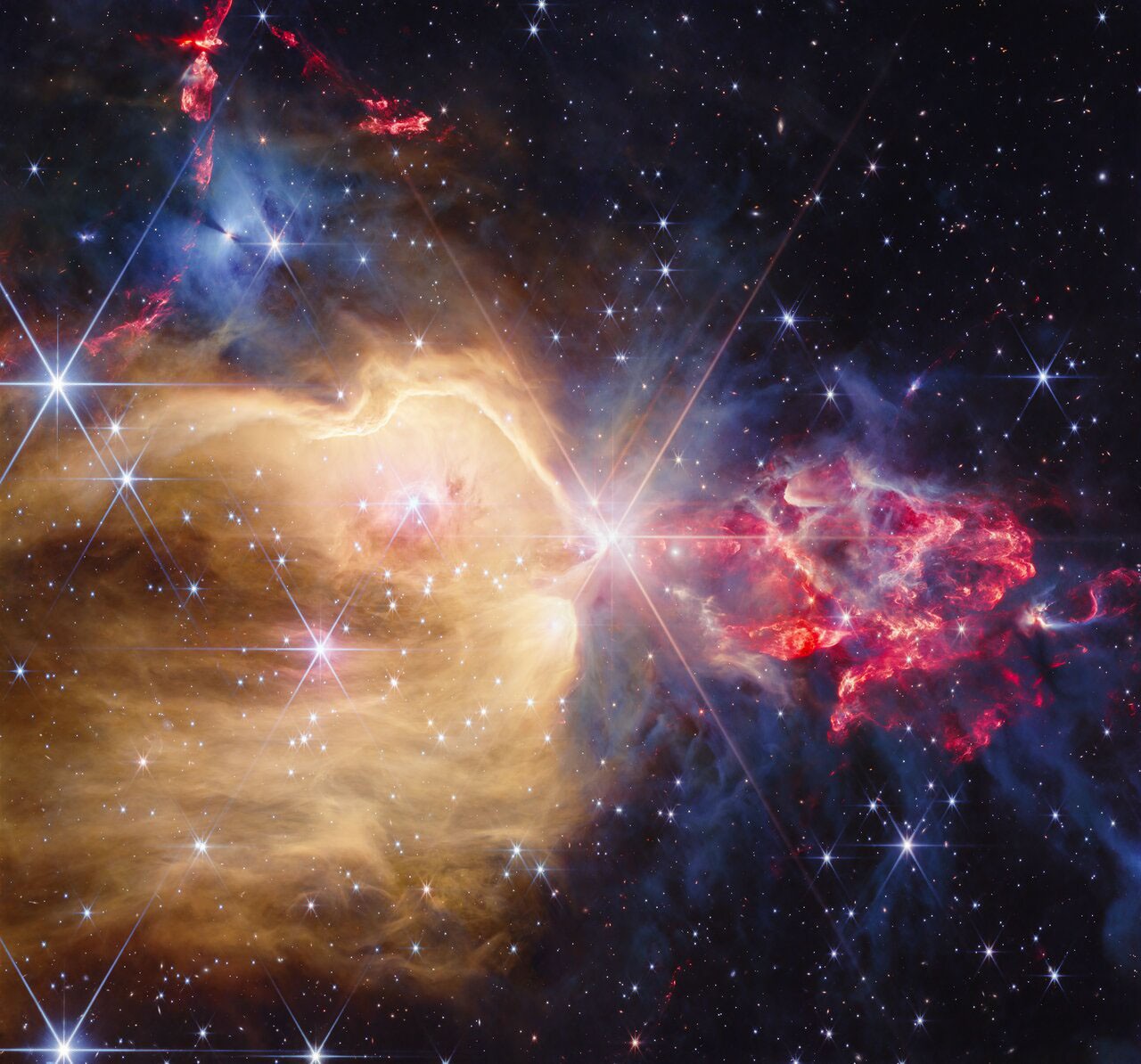
The latest observations from NASA’s James Webb Space Telescope have cast new light—literally and figuratively—on the turbulent processes that shape nascent stars in the cosmic nursery NGC 7129. This star-forming region, located about 3,300 light-years away in the constellation Cepheus, now emerges in unprecedented clarity thanks to Webb’s sharp infrared vision, exposing structures and events long concealed by interstellar dust.
Webb’s composite image, crafted from a battery of near-infrared filters, highlights a sharp divide: on the left, golden clouds of hot, atomic hydrogen gas glow where more mature young stars have already begun reshaping their environment. To the right, the scene shifts to deep reds—here, clusters of protostars are just beginning to collapse under gravity, their earliest outflows shocking and heating the surrounding molecular hydrogen. These powerful jets carve out filamentary shapes across the region, evidence of the intense and sometimes violent interactions that characterize stellar birth.
NASA’s data show not just a tapestry of color, but an evolutionary gradient. The central and left portion of the image hosts stars further along in their lifecycle—young, yet already emitting enough heat and energy to disrupt, break down, and disperse the molecular gas in their vicinity. In contrast, the red-hued rightmost reaches harbor stars so newly-forged that their own outflows physically alter their embryonic envelopes. Despite the dust that obscures such structures in visible light, Webb’s infrared gaze pierces through, making these knots, jets, and clumps plainly visible.
Much of this cosmic choreography was hidden even to earlier generations of infrared telescopes. NASA compares Webb’s detail—down to individual jets and clumped outflows—to previous observations by the retired Spitzer Space Telescope, which saw only fuzzy swathes of gas and dust in NGC 7129. Webb’s data allow astronomers to distinguish actual protostars from their more mature siblings and to trace the feedback mechanisms that both fuel and frustrate further star formation.
The technical achievement is also notable. The image, captured with JWST’s NIRCam instrument, synthesizes exposures taken on December 17, 2025, across five wavelength-specific filters. This approach assigns color to physical properties: blue to faintest, shortest wavelengths; yellow and gold to medium energy regions of atomic hydrogen; red to the shocked molecular hydrogen illuminated by protostellar jets. The coldest, densest pockets—where gravity may yet forge stars from raw material—register as gray veils on the periphery.
For astronomers, studying a single region with so many stars at various stages of maturity offers a rare laboratory for testing theories about what physical processes tip the balance from simple gas clouds to full-fledged stars. In NGC 7129, evidence suggests that the actions of one generation of protostars—their ferocious winds and explosive outflows—may determine when and where the next stars can form, or be prevented entirely.
Webb’s new images mark only a beginning for scientific study. The precise nature of the feedback loops, the chemical transformations within the jets, and the long-term fate of the youngest clumps remain leading questions. But in stripping away the veil of dust and unveiling the violence as well as the beauty of stellar birth, Webb’s NGC 7129 observations deepen our understanding of the cosmos and our own origins within it.