
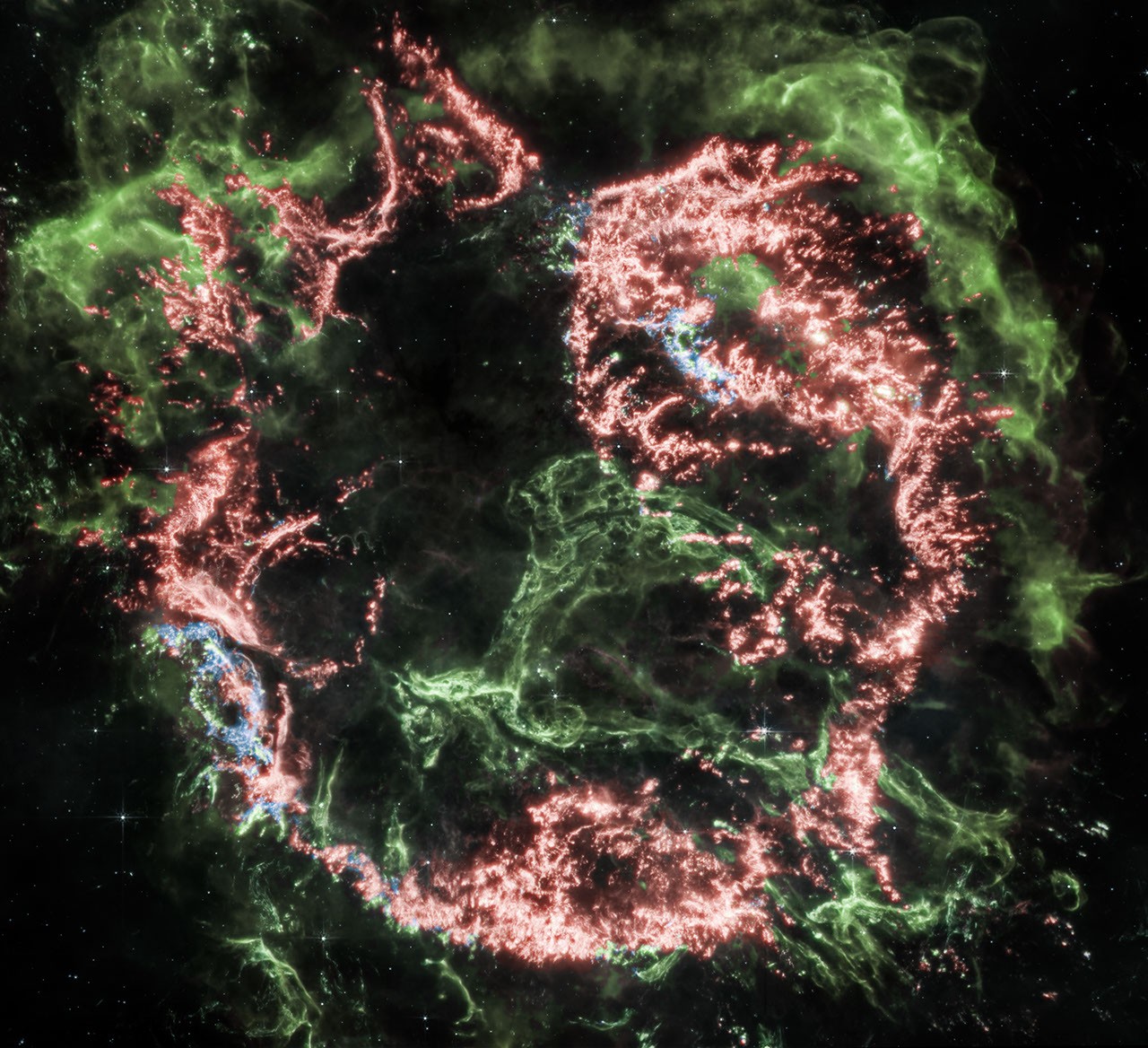
In a breakthrough for the study of stellar life cycles, NASA scientists announced on November 23, 2026, that the James Webb Space Telescope (JWST) has found direct evidence that the internal layers of a massive star merged shortly before its violent end as a supernova. The discovery was made in the supernova remnant Cassiopeia A (Cas A), located over 11,000 light-years from Earth, in the constellation Cassiopeia.
Using high-resolution, mid-infrared imaging, JWST mapped clumps of dust within Cas A, each spanning distances comparable to the size of our solar system. The telescope’s advanced instruments allowed researchers to identify the chemical compositions of these dust grains, revealing distinct regions rich in silica, carbon, or magnesium silicates. According to the NASA research team, the variations in chemical makeup are best explained by a ‘shell merger’—a phenomenon in which the separate burning layers inside a star, responsible for fusing different elements, collapse into each other and mix just hours prior to the star’s destruction.
“Material within these shells churns and circulates, which can cause the shells to merge shortly before the supernova explosion,” said Dr. Tea Temim, the study’s lead author and a research scientist at Columbia University, via statements released by NASA. Previously, astrophysicists theorized such events were possible, but JWST’s observation of Cassiopeia A has provided the strongest direct evidence yet that such mergers occur and that they can fundamentally alter a star’s structure just before it explodes.
The findings, detailed in The Astrophysical Journal Letters, mark a milestone for the astronomy community. As the Cas A supernova remnant is one of the most closely studied objects in the night sky, any new insights into its origins have broad implications. Understanding the final days—and even hours—of massive stars helps explain the diversity of elements scattered across the cosmos, since supernovae are responsible for forging and dispersing many of the elements found across the universe.
While this discovery strengthens scientific models of how stars live and die, questions remain about precisely what triggers these shell mergers and how common they may be. Ongoing and future observations using JWST are expected to probe deeper into the compositions of other supernova remnants, potentially uncovering more examples of these dramatic, last-minute transformations.
NASA’s Webb Telescope continues to redefine humanity’s view of the universe, combining its unique infrared eyes with sensitive instruments to record the afterlives of stars in unprecedented detail, and to encode cosmic history into intricate patterns of dust and light.