
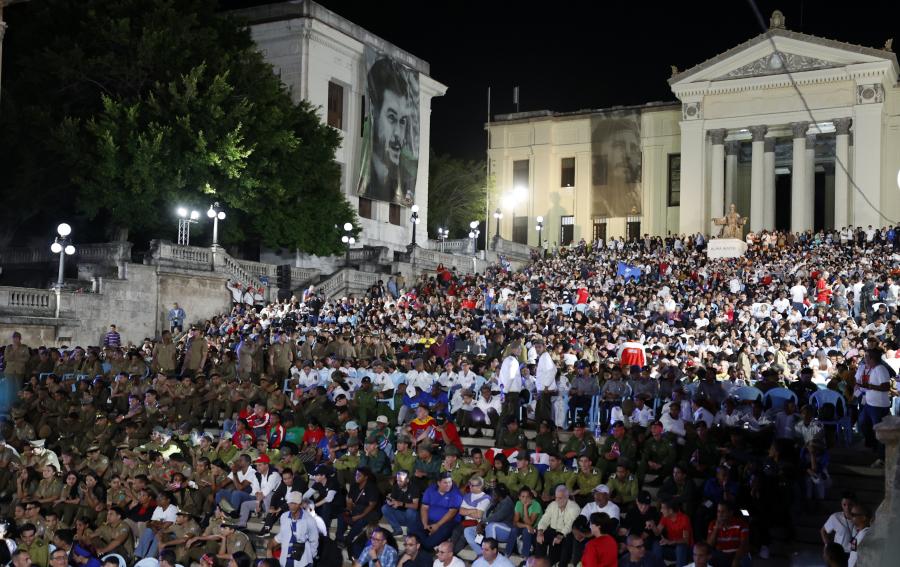
Ten years after Fidel Castro’s death, Cuba commemorated the legacy of its revolutionary leader with a cultural ceremony at the University of Havana on November 26, 2026, reflecting both deep reverence and the burdens the nation currently shoulders. The event, attended by President Miguel Díaz-Canel, members of the Castro family, and hundreds of young Cubans, occurred against a backdrop of persistent hardship and international tension.
Originally scheduled for November 25—the exact date of Castro’s passing in 2016—the memorial was delayed by a day due to a severe weather alert. Despite the postponement, the turnout and tone remained resolute. The ceremony’s program wove together documentary screenings about Castro’s life, children’s choir performances, and a centerpiece ballet—”The Death of the Black Swan”—interpreted by Viengsay Valdés, director of the National Ballet of Cuba. Youth involvement featured prominently, both on stage and in speeches lauding their role as stewards of Cuba’s revolutionary legacy. Meyvis Estévez, the first secretary of the Union of Young Communists, underscored the importance of defending Cuba’s ideals in the face of ongoing external pressure, a clear reference to continued U.S. sanctions and diplomatic strain. (Sources: Plataformamedia, Riotimesonline)
Cuban media coverage framed the anniversary as a national assertion of identity and unity, echoing themes that have long marked official commemorations of Castro’s leadership. Yet this year’s memorial also coincided with the centenary of Castro’s birth, intensifying decades-old debates about his complex inheritance. Since the 1959 revolution, Castro’s figure has dominated the nation’s self-image; his passing in 2016 was widely seen as the end of an era.
The challenges facing his successors could not be ignored. This anniversary arrives as Cuba struggles with acute economic difficulties, including rolling blackouts, food scarcity, and health system disruptions, largely attributed by authorities to U.S. sanctions and an ongoing oil embargo. Independent international outlets report that, while the official ceremony drew broad participation—especially from organized youth—public sentiment about both Castro’s legacy and the state’s performance during these hardships remains hard to gauge; significant organized dissent did not surface in reports surrounding the commemoration. (Sources: Africanews, Riotimesonline)
The international dimension of the anniversary extended beyond Cuba’s borders. Ceremonies were observed in allied countries such as Vietnam, where Cuban Ambassador Rogelio Polanco Fuentes led remembrance events on November 25, underscoring Castro’s role in shaping global solidarities. (Source: VOV English)
For Cuba, the tenth anniversary of Castro’s death is both a moment of remembrance and an occasion for official reflection on what lies ahead. As the island nation marshals its resources and its youth to carry forward the legacy of a leader who defined a half-century of Cuban history, the struggle to resolve economic crisis and navigate fraught international relations continues to define daily life. The path forward, as the commemoration made clear, remains uncertain but fiercely contested—in the spirit of Castro’s enduring imprint on the island’s identity.