
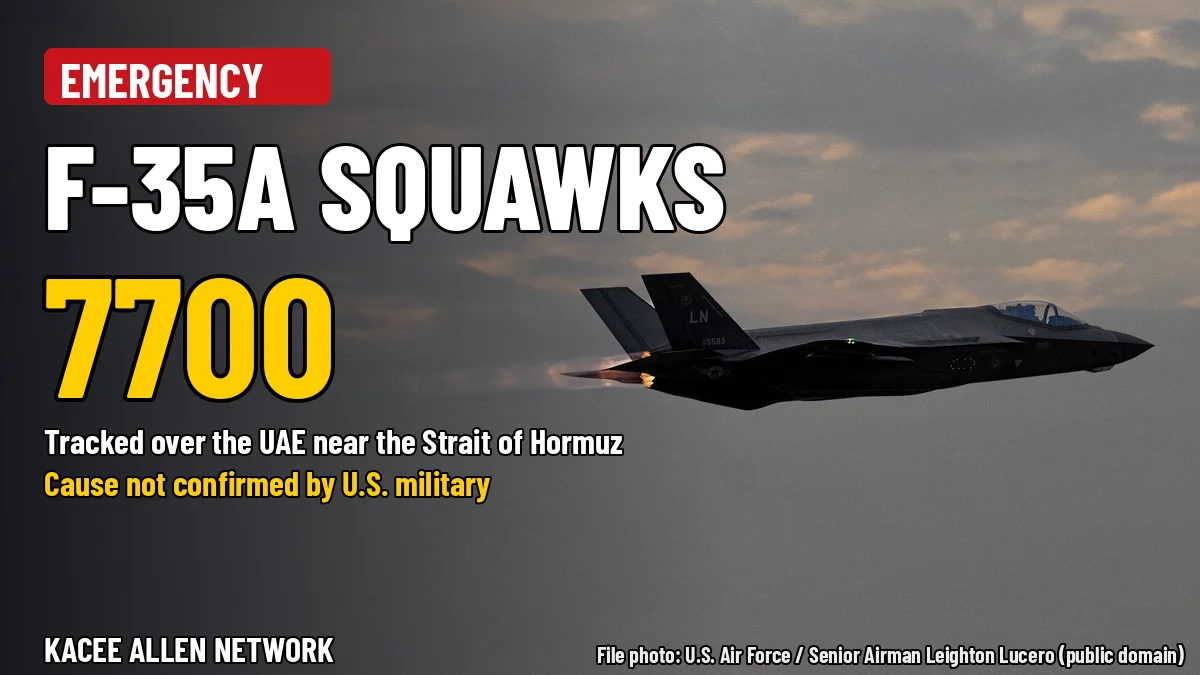
An emergency involving a U.S. Air Force F-35A Lightning II unfolded over the eastern United Arab Emirates in the early hours of November 22 local time, after the aircraft transmitted a 7700 emergency code—an international signal for a general in-flight crisis—while flying at approximately 29,000 feet near Fujairah.
The American stealth fighter, identified as tail number 13-5067, was tracked near the coast northeast of the city, about 20 kilometers from the population center. After broadcasting the distress signal at around 1:41 a.m. local time (4:41 p.m. Eastern Time on November 21), flight tracking indicated the aircraft turned southwest along a trajectory toward Al Dhafra Air Base, a key American military outpost roughly 20 miles south of Abu Dhabi.
Although the aircraft’s path suggested a controlled flight after the emergency code was sent, official confirmation of its safe landing or the fate of its pilot remains unavailable. The U.S. Central Command (CENTCOM) told several outlets that it was not aware of any incident involving an F-35 in the region at that time, deepening uncertainty about the episode’s resolution and highlighting the routine opacity of operational military information.
The cause of the emergency declaration, as well as whether the pilot was forced to eject, has yet to be disclosed. Independent aviation analysts and open-source flight trackers reported the sequence of events, but none could independently confirm the final outcome for the aircraft or its crew.
This marks the second reported emergency involving a U.S. Air Force F-35A in the Gulf region within six months. On May 10, 2026, an F-35A similarly declared an emergency as it flew over the Gulf of Oman but landed safely at Prince Sultan Air Base in Saudi Arabia. That earlier event underscores ongoing scrutiny of F-35A operations in the region but also the difficulty of obtaining timely, clear answers when military emergencies occur far from public view.
U.S. military authorities have launched an investigation into the incident, and further information is expected as they determine the cause and consequences. For now, key facts—including the condition of the pilot and the aircraft—remain unconfirmed, with external observers relying on a patchwork of flight data and official silence.