
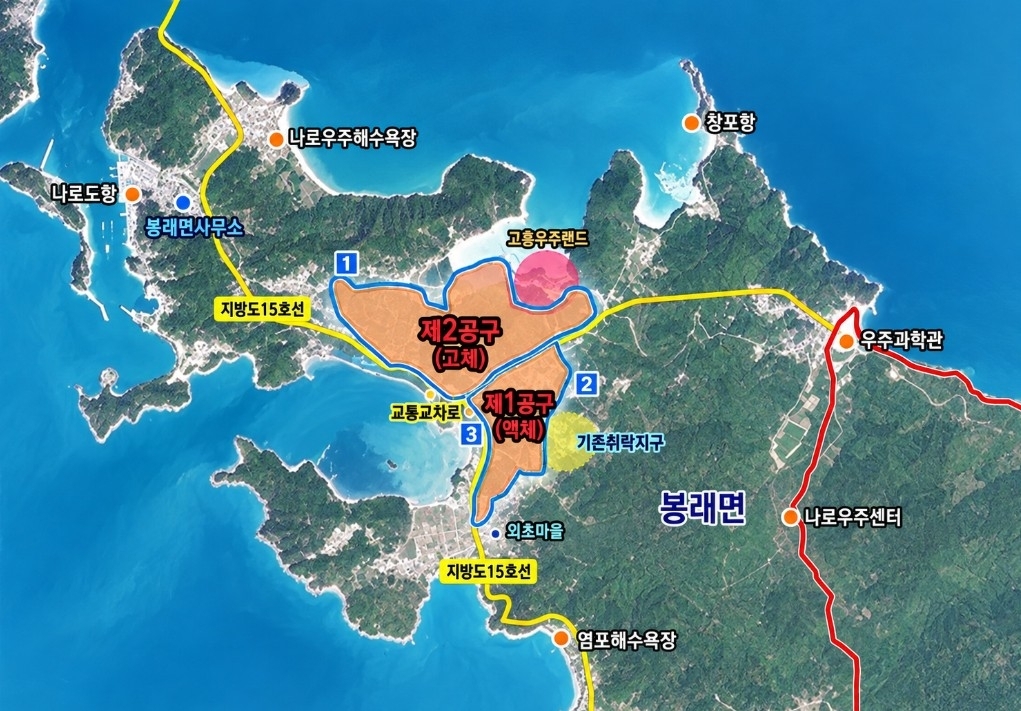
South Korea’s ambitions to become a heavyweight in the global space industry took a decisive leap forward on November 25, 2026, as the nation’s Ministry of Land, Infrastructure and Transport (MOLIT) granted final approval for the Goheung Space Launch Vehicle National Industrial Complex. The project, to be constructed in Bongnae-myeon within Goheung County, Jeonnam-Gwangju, marks the country’s largest coordinated investment in rocket and space launch infrastructure to date—with a reported price tag of 380 billion won, or approximately $260 million.
The sprawling complex will cover 1.52 million square meters (about 460,000 pyeong), anchoring South Korea’s drive to build a true full-cycle ecosystem for space launch vehicle development, from manufacturing and testing to certification and launches. According to government statements reviewed by Korean financial outlets, the Goheung initiative aims to draw in private and state-backed industry leaders, providing purpose-built zones for both liquid-propellant and solid-propellant rocket technologies. One zone will focus on projects from commercial space companies, while a parallel zone will cater to the Agency for Defense Development, which handles military-targeted solid-fuel launch vehicles.
Authorities expect the complex—scheduled to break ground in 2028 and targeted for completion by 2030—to cultivate a vibrant hub of space industry jobs and production. Economic estimates suggest up to 1,673 new jobs will be created and nearly 296 billion won in associated production inducement effects will ripple through the Jeonnam-Gwangju region.
Tenant agreements are already in place with 11 industry-leading companies, including heavyweights like Hanwha Aerospace and Innospace. The Agency for Defense Development is also poised as an anchor tenant, pointing to the site’s dual significance for South Korea’s civil and defense aspirations in space. The industrial hub is also expected to be closely linked with the nearby Naro Space Center—the country’s primary civilian launch facility—as well as a dedicated commercialization center for launch vehicle technology.
The project’s progression has been methodical: Goheung was first proposed as a site for national space industry development in March 2023. The complex was then granted exemption from a standard government feasibility study in June 2024, recognizing its perceived strategic importance. In October 2026, the plan cleared two key levels of central investment and planning review before MOLIT issued its final approval on November 25.
The approval comes amid ongoing efforts to boost South Korea’s standing in space technology and research. Looking ahead, government sources indicate plans for broader infrastructure improvements around Goheung, including a dedicated expressway and an expansion of major arterial routes. Local officials have also announced ambitions to construct a science complex modeled after the United States’ Kennedy Space Center, with the goal of establishing Goheung as a space tourism destination.
Land compensation activities are slated to begin in 2027, with actual construction expected to follow the next year. While enthusiasm is high, especially given the high-profile tenants and the scale of public investment, much depends on smooth implementation—including compensation negotiations and the timely start of construction. Separately, an announcement is expected in December 2026 regarding the potential award of a “second space center,” which could amplify the project’s importance and bolster Jeonnam-Gwangju as a national hub for spaceflight and related industries.
With the final regulatory hurdles now cleared, South Korea’s latest move underscores its determination to join the top ranks of global spacefaring nations—and to unlock the economic and strategic gains that a vertically integrated rocket and launch industry can bring.