
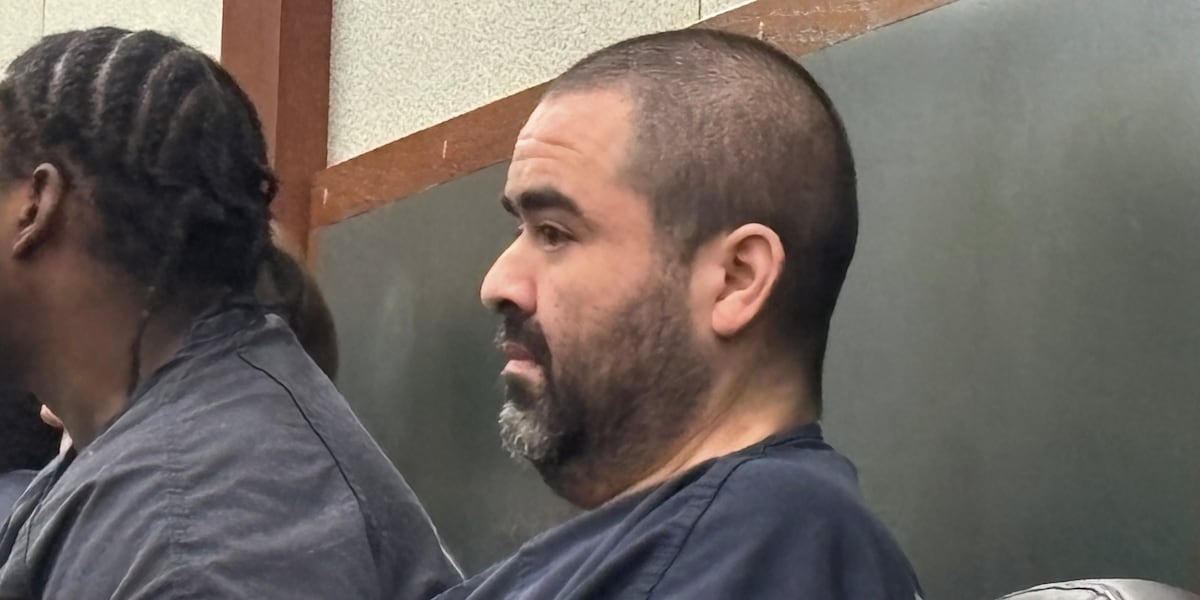
The long-awaited sentencing of Alejandro Estrada, convicted in one of Las Vegas’s most high-profile double homicides of 2026, was abruptly postponed on November 25 due to an administrative error in the court’s scheduling system. Estrada, 43, previously pleaded guilty in October to two counts of murder with a deadly weapon, after fatally shooting his ex-wife and her husband inside a busy Smith’s grocery store this past May.
The violent incident took place around 11:20 a.m. on May 12 at Smith’s Food & Drug on South Maryland Parkway, a routine shopping day that turned tragic as Estrada followed Amanda Frias Rosas and her new husband, Victor Frias Rosas, down an aisle before opening fire. Shoppers fled in panic as shots rang out, but several bystanders acted quickly—subduing Estrada outside the store and preventing further harm until police officers arrived. Both Amanda and Victor Frias Rosas died at the scene.
Court documents and multiple regional news outlets confirm that Estrada’s actions stemmed from what sources described as mounting frustrations over unpaid child support and fears of incarceration. Amanda Frias Rosas was Estrada’s former spouse and the mother of his two children; Victor had married Amanda in the years following the separation.
The case wound its way through the Eighth Judicial District Court, with Estrada formally entering his guilty plea in October. His agreement with prosecutors calls for two consecutive sentences of between 28 years and life, meaning Estrada could only become eligible for parole after serving at least 56 years in prison. The now-delayed sentencing had been set for November 25; it is now rescheduled for December 2, 2026. The postponement, confirmed by official court records and attributed in local reporting to an administrative oversight, left victims’ relatives and the broader community awaiting formal closure on the case.
In the wake of the shooting, Smith’s temporarily closed the store for two weeks to facilitate cleaning and restocking. The tragedy has drawn renewed attention to public safety concerns in Las Vegas, a city that has struggled with high-profile acts of violence in public spaces. Local news highlighted the heroism of those shoppers who intervened on May 12, underlining how ordinary individuals played a critical role in ensuring others were not harmed during the chaos.
The case holds a notable place in the city’s troubled recent history of violent incidents, including a separate high-profile domestic homicide sent to sentencing just weeks earlier. As the December sentencing approaches, the community’s focus turns to the courtroom, where Estrada awaits a formal decision that is expected to keep him incarcerated for the rest of his life. The victims’ families, meanwhile, await a measure of finality and justice after a harrowing year.