
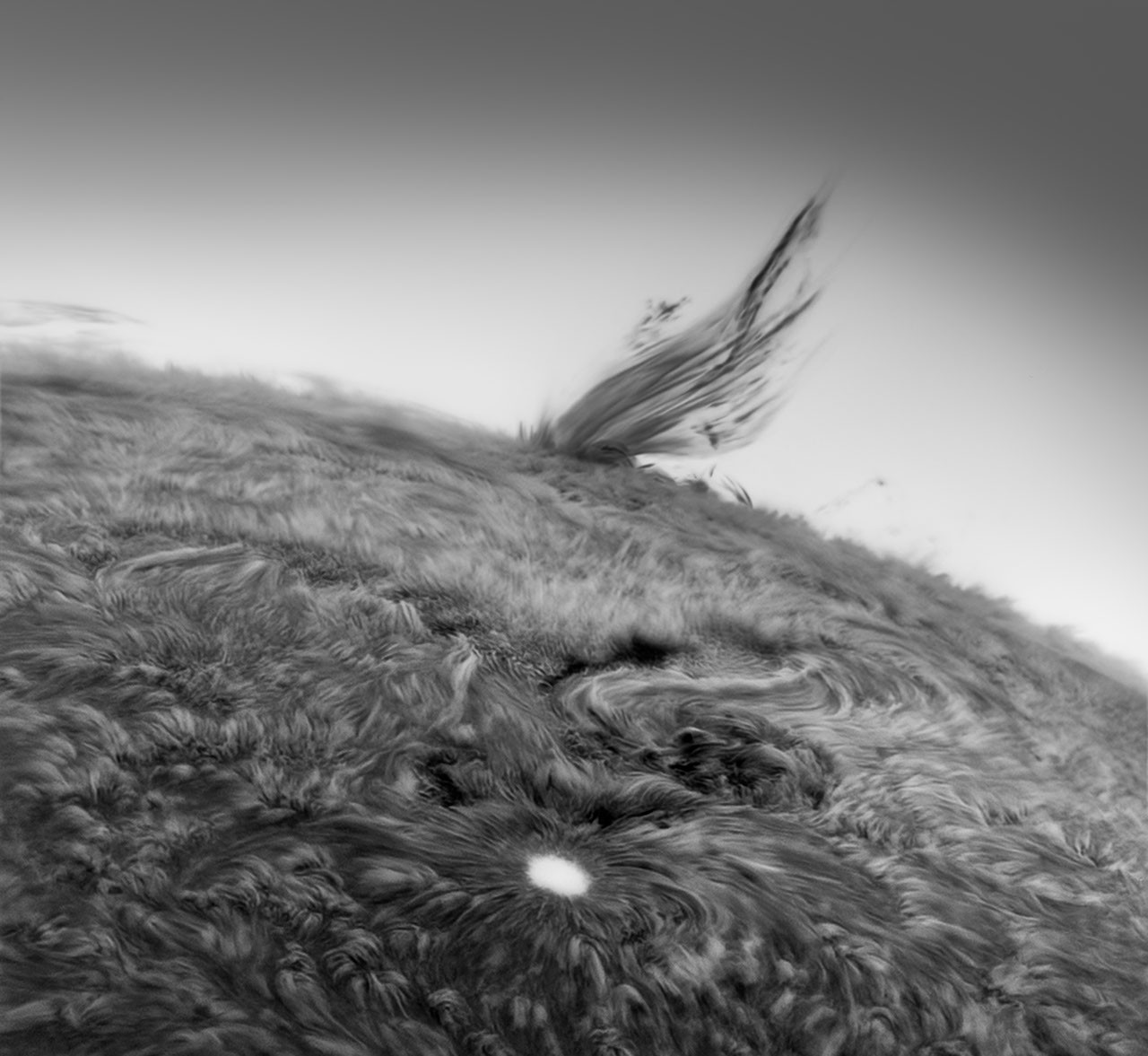
A surge of magnetized energy swept off the Sun’s chromosphere on May 14, 2025, providing scientists a fleeting window to capture the intricacies of a solar flare in real time. Coordinating with this unpredictable event, NASA’s FOXSI-5 rocket launched from Alaska’s Poker Flat Research Range, setting a milestone for solar physics observation by leveraging an innovative solar flare alert system to trigger precisely as a flare unfolded.
The May 2025 flare, documented in NASA’s Astronomy Picture of the Day for November 18, 2026, was classified as an M1 on the GOES (Geostationary Operational Environmental Satellites) X-ray scale—a moderate, though consequential, burst of energy. While not the Sun’s most powerful outbursts, M-class flares carry implications for space technology and human activity; they can spark radio blackouts near Earth’s poles and provoke minor radiation storms that threaten astronauts and orbiting equipment.
The achievement hinged on a critical advance: a new flare alert system capable of pinpointing both the timing and location of solar flares with unprecedented speed. Traditionally, sending a sounding rocket into a flare remained a high-stakes gamble—solar explosions can ignite and vanish in minutes, while rockets like FOXSI-5 have brief observational windows of about five minutes after launch. The enhanced system, detailed in a November 2026 NASA account, analyzed X-ray and ultraviolet emissions from magnetically active regions on the Sun, drawing real-time data from NASA’s Solar Dynamics Observatory, NOAA’s GOES satellites, and ground-based telescopes. This swift analysis enabled the rocket’s team to launch with confidence, capturing not just one but three small flares in a single flight.
At the heart of FOXSI-5’s mission was the study of how the Sun’s magnetic fields tangle, twist, and occasionally snap, expelling torrents of light and energetic particles. Special H-alpha optical filters tracked energized hydrogen atoms expelled during the flare, offering scientists crucial data about how heat and radiation travel outward from the Sun’s surface. The measurements help demystify a core solar puzzle: the paradoxical rise in temperature moving away from the solar core, a phenomenon believed to be fueled by magnetic field interactions rather than the core’s baseline heat alone.
This real-time response capability reflects broader progress in space weather preparedness. By demonstrating a working early-warning system for solar flares, NASA and its partners improved positioning for future missions to observe and understand the Sun’s volatile behavior. The alert system, part of an ongoing NASA Early Career Investigator Program grant, now serves as a model for coordinated rocket campaigns and solar observatories seeking precise timing for transient solar events. Moreover, consistent monitoring by NASA and NOAA remains pivotal for radiation forecasting, ensuring the safety of astronauts and pole-traversing pilots—and, ultimately, the resilience of technological infrastructure dependent on uninterrupted radio and satellite service.
While the May 2025 rocket campaign stands as a technical feat, one central mystery endures: why the solar atmosphere grows inexplicably hotter the farther it is from the Sun’s core. The recent data haul from targeted flare observations brings solar physicists a step closer to a resolution, sharpening humankind’s understanding of the dynamic star that fuels all life—yet reminding us that the Sun’s inner workings are far from fully mapped.