
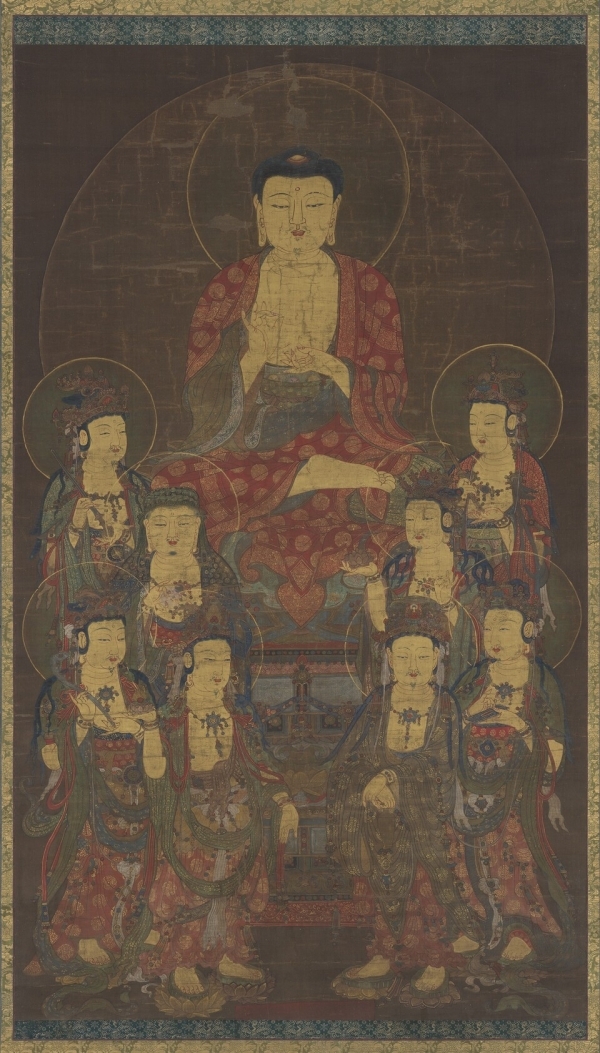
A rare and significant 14th-century Goryeo Buddhist painting, titled “Amitabha and the Eight Great Bodhisattvas,” is now the focus of an ambitious two-year restoration effort in South Korea, marking a noteworthy chapter in the stewardship of East Asian cultural heritage.
Currently part of the collection at the Asian Art Museum (AAM) in San Francisco, this large hanging scroll—measuring 151.1 cm by 88.7 cm, and mounted at over 2.6 meters tall—was transported to Korea earlier this year. The restoration is funded by Riot Games as part of its continuing commitment to the preservation and return of Korean cultural heritage.
The painting itself, depicting Amitabha Buddha flanked by eight bodhisattvas in serene yet powerful detail, is one of only about ten such extant Goryeo Buddhist paintings worldwide. Scholars recognize it as a paragon of Pure Land Buddhist iconography and a testament to the artistic heights reached during Korea’s Goryeo dynasty (918–1392). These paintings are prized for their intricate compositions and subtle colorwork, and are seen as among the finest achievements in East Asian Buddhist art (see edgepedia.org/asia-archive.si.edu).
Originally acquired for the Asian Art Museum by Avery Brundage, a former president of the International Olympic Committee, and donated to the museum in 1972, the painting has traveled a storied path towards preservation and renewed recognition. Thanks to the Overseas Cultural Heritage Preservation and Restoration Support Project, Riot Games has extended its decade-long support for repatriation efforts to include conservation, underlining a growing trend among private organizations to contribute to cultural preservation in tangible ways.
Restoration work is well underway in Korea and is scheduled for completion in 2028. Afterward, the painting will be unveiled to the public through a series of domestic and international exhibitions, aiming to both celebrate the restoration and deepen appreciation of Korea’s Goryeo-era artistry among global audiences.
There have been no reported issues or controversies regarding the transfer or treatment of the painting. As the delicate process continues, art historians and cultural heritage advocates alike await the finished result, hopeful it will shine new light on one of the Goryeo period’s most remarkable artistic legacies.