
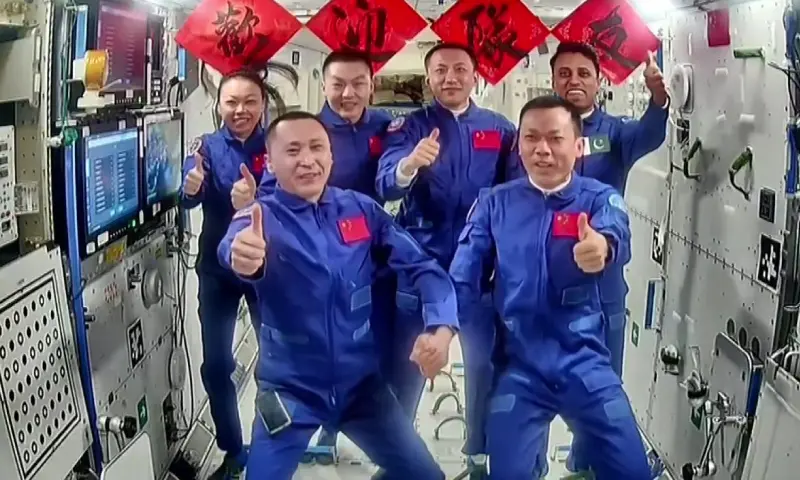
Early on November 25, Pakistani Air Force pilot Muhammad Zeeshan Ali became his nation’s first astronaut by docking with China’s Tiangong space station as a payload specialist aboard Shenzhou-24. In a development celebrated in both Islamabad and Beijing, Ali’s arrival onboard the orbiting laboratory marks the first time a non-Chinese astronaut has participated in a Chinese crewed mission, turning a new page in China-Pakistan cooperation in space.
Launch and Mission Details
Shenzhou-24 lifted off from the Jiuquan Satellite Launch Center in northwestern China, carrying a three-person crew: two Chinese astronauts and Ali, a 40-year-old with nearly two decades of pilot experience in Pakistan’s air force. After a smooth ascent, the spacecraft completed a successful docking with Tiangong just over three hours later, beginning a short but symbolically significant residency for Ali.
While most Chinese spaceflights last six months, Ali’s role as payload specialist will keep him on board for a planned five to ten days. During this period, he will oversee several experiments, with one confirmed as a study on cyanobacteria photosynthesis. The rest of the crew is expected to complete more than 90 scientific experiments and technology tests over the duration of the mission.
Diplomatic and Scientific Significance
Ali’s participation is the fruit of a bilateral agreement sealed between China and Pakistan in February 2025. The pact set the course for joint astronaut training and collaboration, part of a broader strategy for both countries to expand their capabilities and prestige in space research. The mission’s success is being closely watched by international observers as China positions itself as a new partner for nations aspiring to send astronauts into orbit—potentially rivaling the avenues traditionally provided by the United States and Russia.
The symbolism is strong: Ali’s journey drew widespread acclaim and emotion in Pakistan, where citizens, students, and government officials hailed the launch as a national triumph. Crowds in Islamabad reportedly cheered as the Shenzhou-24 launch streamed on television, with officials calling Ali an ambassador of Pakistani ambition and technological progress. “You’ve made history for all of us,” was a common refrain among onlookers and students interviewed by outlets such as The Straits Times and Al Jazeera.
Looking Forward: Growing Ambitions
For Ali and Pakistan’s fledgling astronautics community, the mission is both a podium and a springboard. In public statements issued before launch, Ali expressed hopes that this flight would not be the last, voicing aspirations for future joint missions with China that might extend to more complex spaceflight, lunar and Mars exploration. Pakistani officials have echoed these ambitions, looking to translate this breakthrough into greater scientific and engineering capacity at home.
China likewise signals that its space station could serve as a platform for more international astronauts in coming years, reinforcing its desire to shape ever-broader coalitions in high-tech frontiers. For now, Muhammad Zeeshan Ali’s mission stands as both a singular historic first and a sign that Pakistan’s space-faring era has begun in earnest—propelled by partnership and a shared vision among Asian nations determined to leave their own mark on space history.