
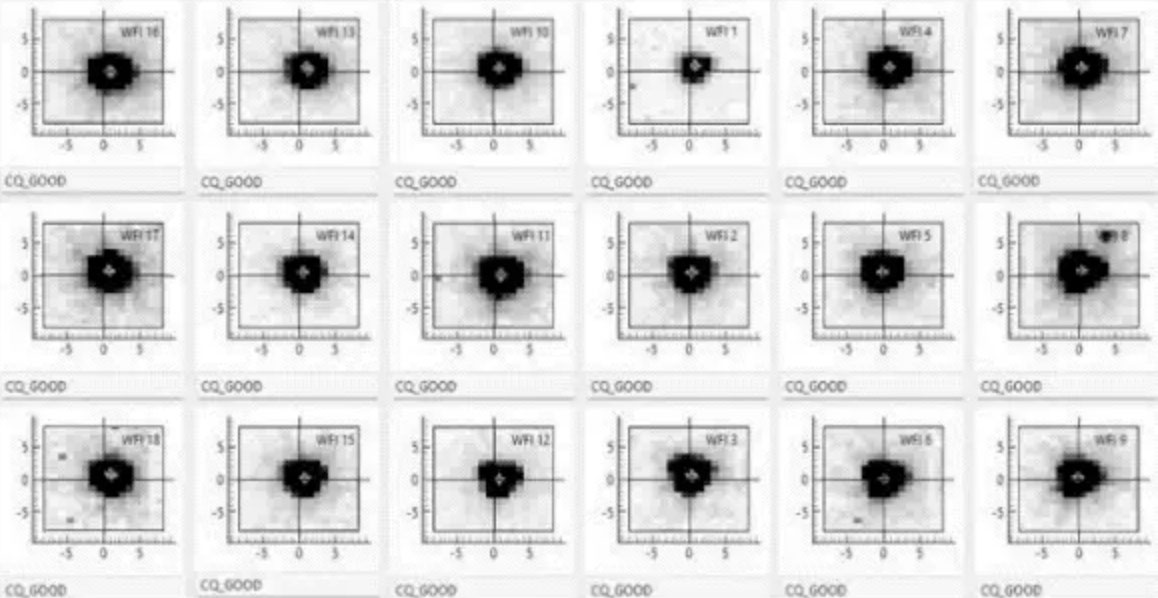
Photo: NASA/Roman Space Telescope Fine Guidance Sensor team
NASA’s Nancy Grace Roman Space Telescope has crossed a major threshold in its journey to unlock the universe’s most profound secrets. On November 13, 2026, NASA announced the precise alignment of the observatory’s two principal instruments—the Wide Field Instrument (WFI) and the Coronagraph Instrument (CGI)—at the agency’s Goddard Space Flight Center in Greenbelt, Maryland.
This alignment marks a pivotal moment in the telescope’s commissioning phase, enabling Roman to move from testing to near-ready status for scientific operations. Achieving such precision was essential: according to NASA’s team, Roman must be at least ten times more stable during observations than the Hubble or Webb telescopes to deliver its ambitious science goals. Instrument scientist Dominic Benford emphasized, “Roman’s power comes from two things: how big a view it gives us, and how small we can make the uncertainties in its measurements.”
The Instruments: Enabling New Vistas
The WFI is a 300-megapixel infrared camera designed to capture vast swaths of the sky—at least 100 times the field of view of Hubble. Meanwhile, the CGI is a groundbreaking technology demonstration for blocking blinding starlight, potentially allowing astronomers to directly image exoplanets and inspect planet-forming disks in previously inaccessible detail.
Following exhaustive post-launch adjustments—necessitated by the subtle shifts caused by launch vibrations, the temperature of space, and the absence of gravity—the Roman team used a series of test observations to realign the telescope’s internal optics and update their “internal map.” This map is vital for guaranteeing that stars are captured in exactly the expected positions on the instrument’s detectors, a prerequisite for both stable guiding and sharp imaging. In the words of astronomer Tony Sohn, the telescope is now “internally aligned to within a tiny fraction of a hair’s breadth of perfection.”
Toward First Science
With the instruments now working in sync, Roman proceeds to its final commissioning steps: the calibration of the CGI’s deformable mirrors, containing over 3,000 movable elements. This active starlight control, soon to be attempted for the first time in space, is essential for the coronagraph’s promise to reveal faint planets near brilliant stars. Only after this intricate calibration will the observatory be able to pursue its scientific mission in full force.
The telescope, which launched on August 30, 2026, is expected to begin regular science operations in early 2027. Its mandate is ambitious, aiming to address fundamental questions surrounding dark energy, exoplanets, and cosmic origins. Research teams anticipate a flood of data—the highest daily data rate ever for a NASA astrophysics mission—from wide-field sky surveys and direct imaging efforts enabled by its newly aligned instruments.
As the Roman team prepares for the next and final stage of commissioning, anticipation within the astronomical community is high. With the exacting alignment of its instruments now complete, the Roman Space Telescope stands poised to open a new era of discovery across the cosmos.