
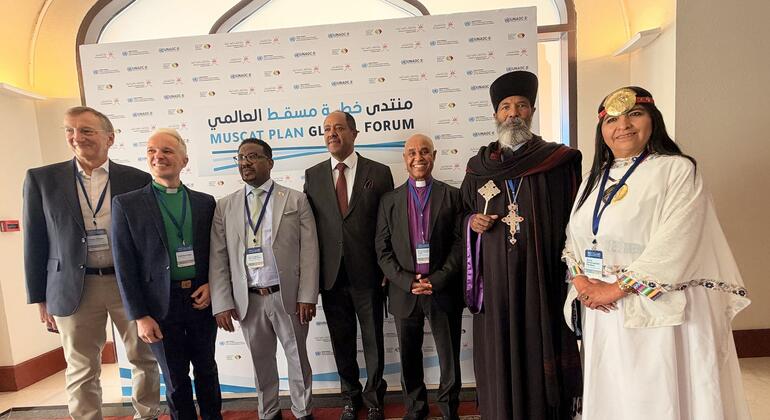
Calls for meaningful empowerment rather than symbolic acknowledgment resounded in Muscat, Oman, as the Muscat Plan of Action Forum convened on November 15. Convened alongside the International Day for Tolerance, the forum gathered United Nations officials, religious, traditional and Indigenous leaders, and youth representatives from over 20 countries to develop practical approaches to hate prevention and peacebuilding.
The forum follows the June launch of the Muscat Plan of Action—a joint initiative by Oman, the UN and international partners—aimed at stepping up community-rooted responses to hate speech, intolerance and incitement before they escalate into violence or atrocities. Unlike previous top-down campaigns, this effort centers on translating international principles into locally tailored actions, emphasizing dialogue, mediation and community trust as key lines of defense.
Mohamed bin Said bin Khalfan Al-Maamari, Oman’s Minister of Endowments and Religious Affairs, argued that sustainable peace is not achieved by government directives alone but by institutions embedding themselves in community trust and shared values. “What we need today is for the legitimacy of institutions to be integrated with the trust of communities and for specialised knowledge to meet inherited wisdom,” he stated, framing traditional and Indigenous leaders as uniquely equipped to reach people often bypassed by official channels.
Chaloka Beyani, UN Special Adviser on the Prevention of Genocide, pressed for such leaders to play full roles in combating hate speech and forestalling collective violence—roles former Finnish President Tarja Halonen said must precede visible conflict, not merely follow it. Halonen warned that unchecked intolerance can gradually sever social bonds, making once-neighborly communities hostile, and called for cooperation across governments, faith groups, and civil society, especially emphasizing women and youth.
Sonia Astuhuaman Pardave, a Quechua women’s counsellor from Peru, offered an Indigenous perspective rooted in mutual respect and shared destiny: “Harming others is harming oneself.” She described Indigenous strategies for defending rights—organising, spirituality, and legal recourse that reject violence in favor of community strength.
The forum also spotlighted the next generation. Youth representatives joined mediation and religion training workshops, sharing strategies for dissecting and healing conflict in their own communities. Colombian advocate Florencio highlighted the difficulty and promise of involving underrepresented groups. Lebanese international relations student Kelly Ketchedjian detailed training that included tackling gender-based violence and understanding complex divisions, reinforcing the view that young people are both vulnerable in conflict and critical to forging solutions.
The crux of the forum was practical: workshops aimed to finalize a global implementation framework and a menu of concrete local, national, and regional steps for the plan. Rather than imposing universal prescriptions, participants pushed for adaptation to each community’s unique realities, guided by committed local dialogue and mediation before tension tips into violence.
As leaders and youth collectively draft the next phase of the Muscat Plan of Action, the challenge persists: Will earnest partnership with community-rooted voices translate into tangible early intervention against hate and violence—or remain an aspiration debated in conference halls?