
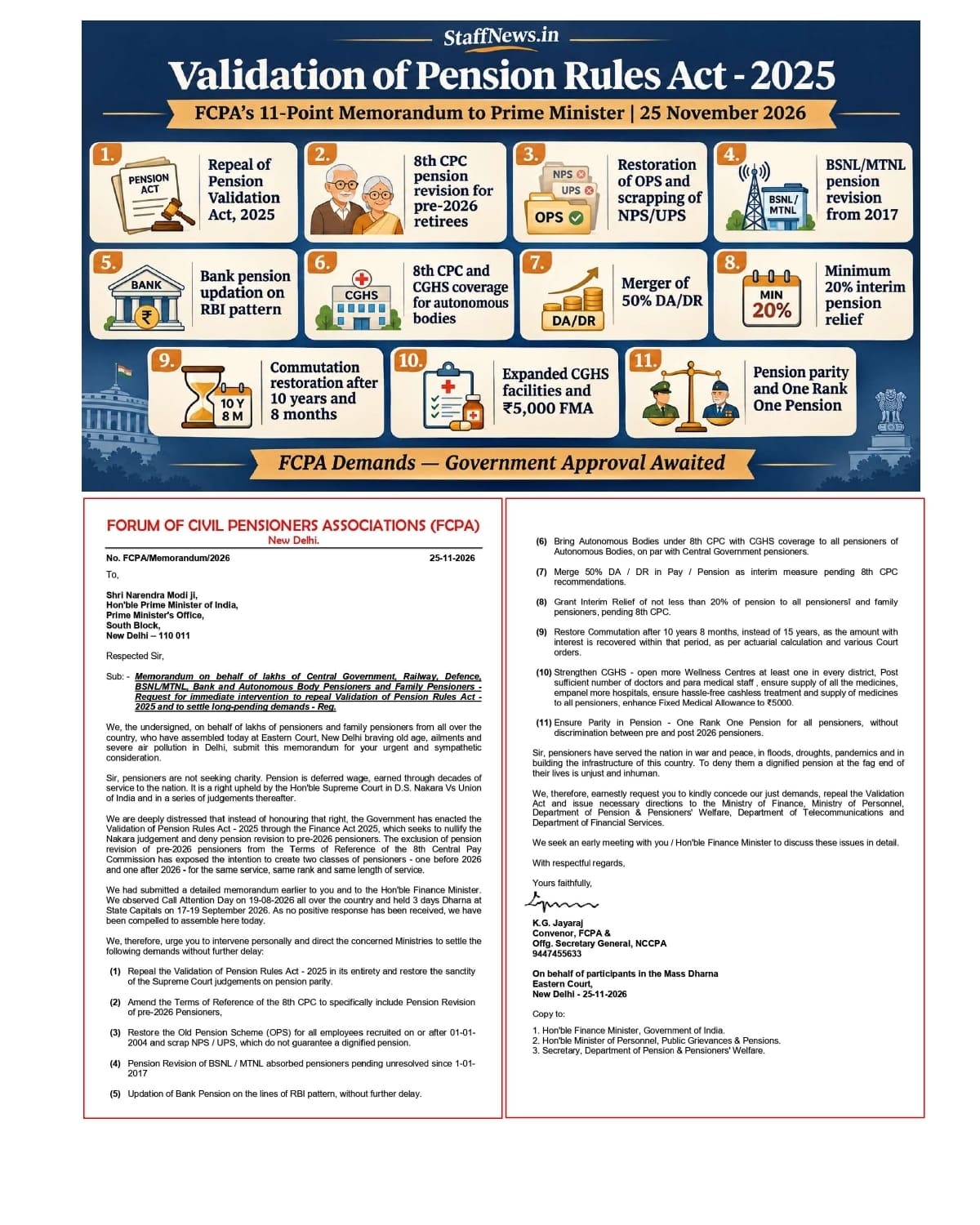
NEW DELHI — A coalition representing government pensioners, the Forum of Civil Pensioners Associations (FCPA), submitted an 11-point memorandum to Prime Minister Narendra Modi on November 25, 2026, intensifying its campaign for comprehensive pension reforms ahead of the 8th Central Pay Commission’s impending recommendations.
Presented at the Eastern Court in New Delhi, the FCPA’s demands reflect mounting anxieties among India’s retired employees regarding the future of their pensions. Among the focal issues is the call for repealing last year’s Validation of Pension Rules Act, a law many pensioners say contradicts the Supreme Court’s landmark 1983 D.S. Nakara judgment that enshrined pension parity for retirees. According to FCPA, this statute jeopardizes equal treatment for pensioners and could deepen disparities between different cohorts of retirees.
The associations are also urging the government to clarify the 8th Pay Commission’s Terms of Reference, ensuring pension revision for those who retired before January 1, 2026, is included. This is particularly significant for older pensioners who fear their benefits could be frozen should the new commission overlook their case.
A major plank of the memorandum is the restoration of the Old Pension Scheme (OPS) for employees hired since 2004 and the discontinuation of the National Pension System (NPS) and Unified Pension Scheme (UPS). Many public sector employees have long expressed dissatisfaction with the defined-contribution nature of NPS, pushing for a return to the defined-benefit OPS, which is seen as more secure for post-retirement livelihoods.
Other notable demands include retrospective pension revision for those absorbed into BSNL and MTNL from January 2017, updating bank employee pensions along the lines previously established for Reserve Bank of India retirees, and expanding the new pay panel’s benefits to workers at autonomous institutions. The FCPA has also advocated for the merger of 50% Dearness Allowance (DA) and Dearness Relief (DR) with basic pay and pension as a stopgap until the 8th Pay Commission’s new scale is rolled out, as well as 20% interim pension relief for all current pensioners awaiting the new dispensation.
The memorandum further addresses operational concerns: calling for the commutation recovery period (the time a pension is reduced to offset lump-sum withdrawal) to be shortened from 15 years to 10 years and 8 months, and for urgent improvements in the Central Government Health Scheme (CGHS), such as establishing wellness centers in every district, recruiting more medical staff, and ensuring the supply of medicines and hospital partnerships.
As of November 27, 2026, there has been no official government response to these demands. The 8th Pay Commission, constituted in November 2025, has yet to issue its recommendations and is expected to review the FCPA’s memorandum as part of its ongoing consultations. The pensioners’ associations, already mobilizing considerable public support, insist that the stakes go beyond economics, touching fundamental issues of fairness and social security for India’s elderly.
With millions of pensioners and their families affected by these policies, the government’s handling of the FCPA’s demands is likely to have significant social and political repercussions in the coming months. Central administration officials have not made any statements as of press time, and the timeline for both the Pay Commission report and any official government reply remains uncertain.
Reporting for this article is based on documentation seen by GREIGNOR News and the details published by the Forum of Civil Pensioners Associations as cited in staffnews.in (November 25, 2026).