
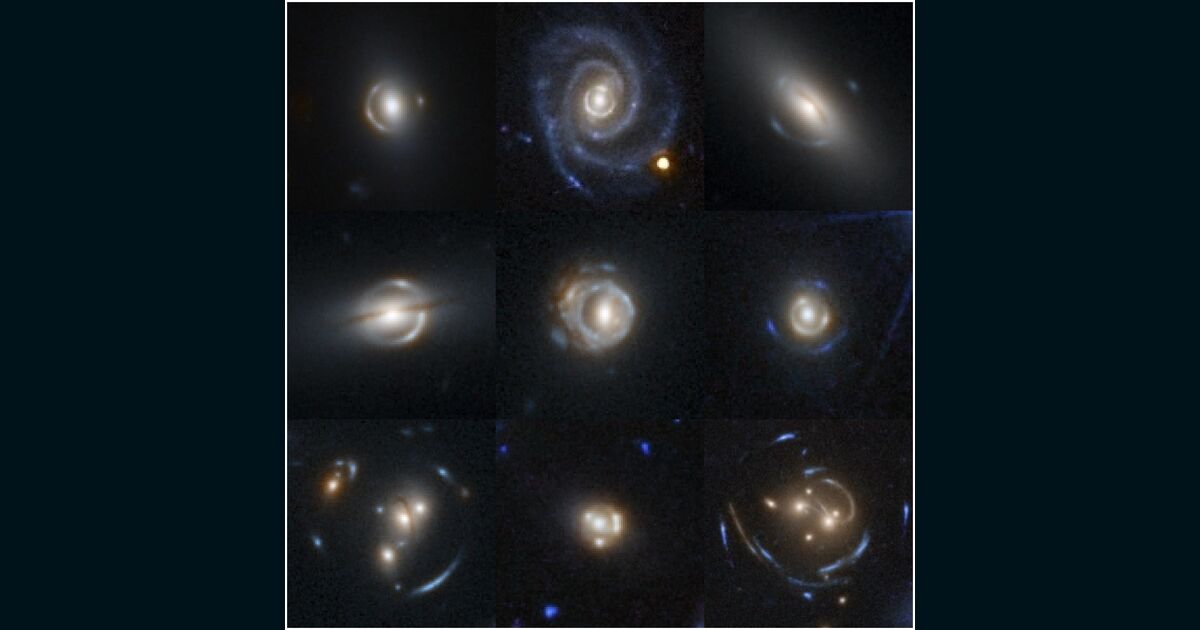
The European Space Agency’s Euclid space telescope has unveiled what astronomers say is the most extensive catalogue of strong gravitational lenses ever assembled, identifying around 15,000 new candidates—more than all previously known examples combined. The discovery is being hailed as a major breakthrough in the effort to understand the mysterious components driving the universe’s evolution, including dark matter and dark energy.
The dataset, known as DR1-Foundation and released on November 12, 2026, encompasses imagery and measurements of over one billion celestial objects and covers nearly five percent of the night sky, an area equivalent to 9,500 full moons. The project’s sheer scale rivals all past surveys, with a data volume exceeding 1.7 million gigabytes, analyzed by a global network of more than 2,000 scientists.
Strong gravitational lenses—sometimes described as cosmic ‘magnifying glasses’—form when a massive galaxy’s gravitational pull warps the light of more distant background objects. The phenomenon, predicted by Einstein in 1936, allows astronomers to probe the otherwise invisible distribution of dark matter within and around galaxies. Before the Euclid catalogue, astronomers had identified fewer than 1,000 such lenses since their first observation.
The new catalogue is notable for its unprecedented diversity. Scientists have identified not only classic galaxy-galaxy lensing but also compound systems involving multiple background galaxies at varying distances, rare disc galaxy lenses, galaxy group lenses creating dramatic arcs, as well as lensed quasars—a type particularly valuable for studying the universe’s expansion rate.
Each lens acts as a natural laboratory, offering clues to the mass components of galaxies, the structure and behavior of dark matter halos, and the underlying rate at which the universe is expanding. Because lensed quasars and other rare systems can serve as cosmic timekeepers, their discovery may help resolve long-standing cosmological puzzles about how dark energy drives the universe apart.
Launched in July 2023, the over $1 billion Euclid mission is designed to map at least one-third of the entire sky and create a 3D map of the cosmos. While this first public data release offers a glimpse into the mission’s scientific promise, further data and analysis will be needed to confirm the lens candidates’ properties and tease out deeper implications for fundamental physics.
ESA scientists and the Euclid Consortium expect future data releases to expand this lens catalogue even further, strengthening what is already a foundation-shifting leap for cosmology and dark matter research.