
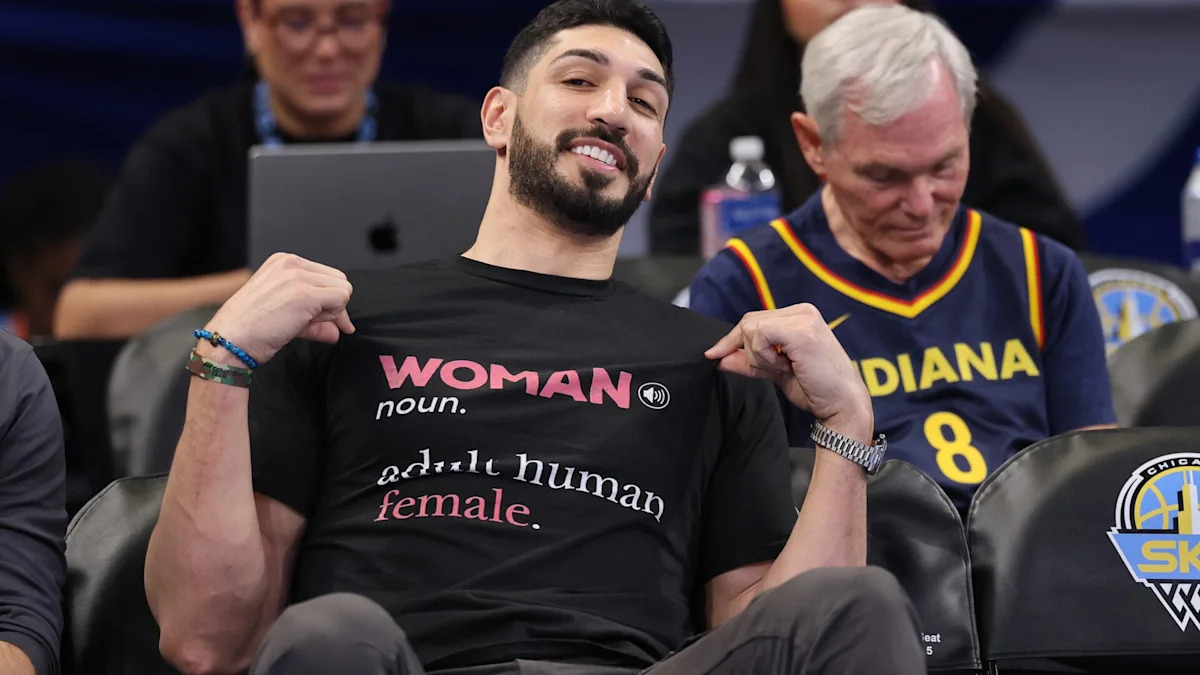
Enes Kanter Freedom, the former NBA star and outspoken activist, has reignited debate over gender eligibility in professional sports with a pointed ultimatum to the Women’s National Basketball Association (WNBA). On November 26, 2026, Kanter Freedom declared that he would “drop everything today” if the WNBA incorporated the term “biological” into its collective bargaining agreement. Until such a change is made, he stressed, he reserves the right to enter the WNBA draft—a stance that has amplified tensions already simmering over his prior declarations and high-profile public appearances.
Kanter Freedom, who in August 2026 declared himself eligible for the 2027 WNBA draft by asserting his self-identification as a woman, has leveraged the league’s current, vaguely worded eligibility criteria for women. The WNBA’s collective bargaining agreement specifies that only women may play, but does not articulate a precise definition of the term or an explicit policy for transgender athletes. This ambiguity has positioned Kanter Freedom’s declaration as both a test of league protocols and a lightning rod for broader societal debates.
Public Incidents and Institutional Response
The controversy escalated sharply during an August 23 game between the Indiana Fever and the Chicago Sky, when Kanter Freedom was ejected after a courtside confrontation with Sky guard Natasha Cloud. Wearing a shirt emblazoned with the phrase “WOMAN noun. adult human female,” his presence and actions led the Chicago Sky to ban him from their home games. Team owner Michael Alter cited concerns about potential disruptions for enforcing the ban, indicating that he would only be permitted to return upon proof he could attend without creating a disturbance.
Tensions flared again during the WNBA Finals on October 21, 2026. Kanter Freedom was denied entry to Game 3 at Atlanta’s State Farm Arena after refusing to accept a private suite, arranged for his own safety, and insisting instead on occupying his purchased seat. Security ultimately ejected him from the event, underscoring the logistical and reputational challenges his campaign poses to league officials.
League and Players Draw Boundaries
The WNBA’s position on player eligibility was reaffirmed in October when Commissioner Cathy Engelbert told Congressman Marlin Stutzman that both Kanter Freedom and fellow former NBA player Royce White are ineligible, stating unequivocally that “only women are eligible to play in the WNBA.” To date, neither the league nor its players’ union has issued new rules in response to challenges over gender criteria. The WNBA Players’ Union, meanwhile, emphasized its commitment to justice, equity, diversity, and inclusion, vowing not to serve as “political pawns” and reiterating the dual aims of protecting women’s sports and supporting meaningful transformation.
Throughout 2026, Kanter Freedom’s increasingly visible effort has spurred both supportive and critical public commentary, reflecting deep societal divisions over gender, fairness, and the future of women’s competitions. His history as an NBA veteran and as a high-profile advocate for human rights abroad has only heightened the spotlight on his advocacy in the sporting and cultural arena.
Legal and Cultural Uncertainty
So far, no court has directly ruled on the eligibility of transgender or self-identifying athletes in the WNBA, and the current collective bargaining agreement’s silence on precise definitions continues to fuel debate. The legal gray zone, and Kanter Freedom’s latest ultimatum, have pushed the issue to the forefront as the league, its players, and policymakers weigh their next moves.
The situation remains fluid as of November 26, 2026, with no significant new developments from the WNBA or external legal authorities. The debate is expected to continue, setting the stage for further negotiation—and potential confrontation—over the coming season and beyond.