
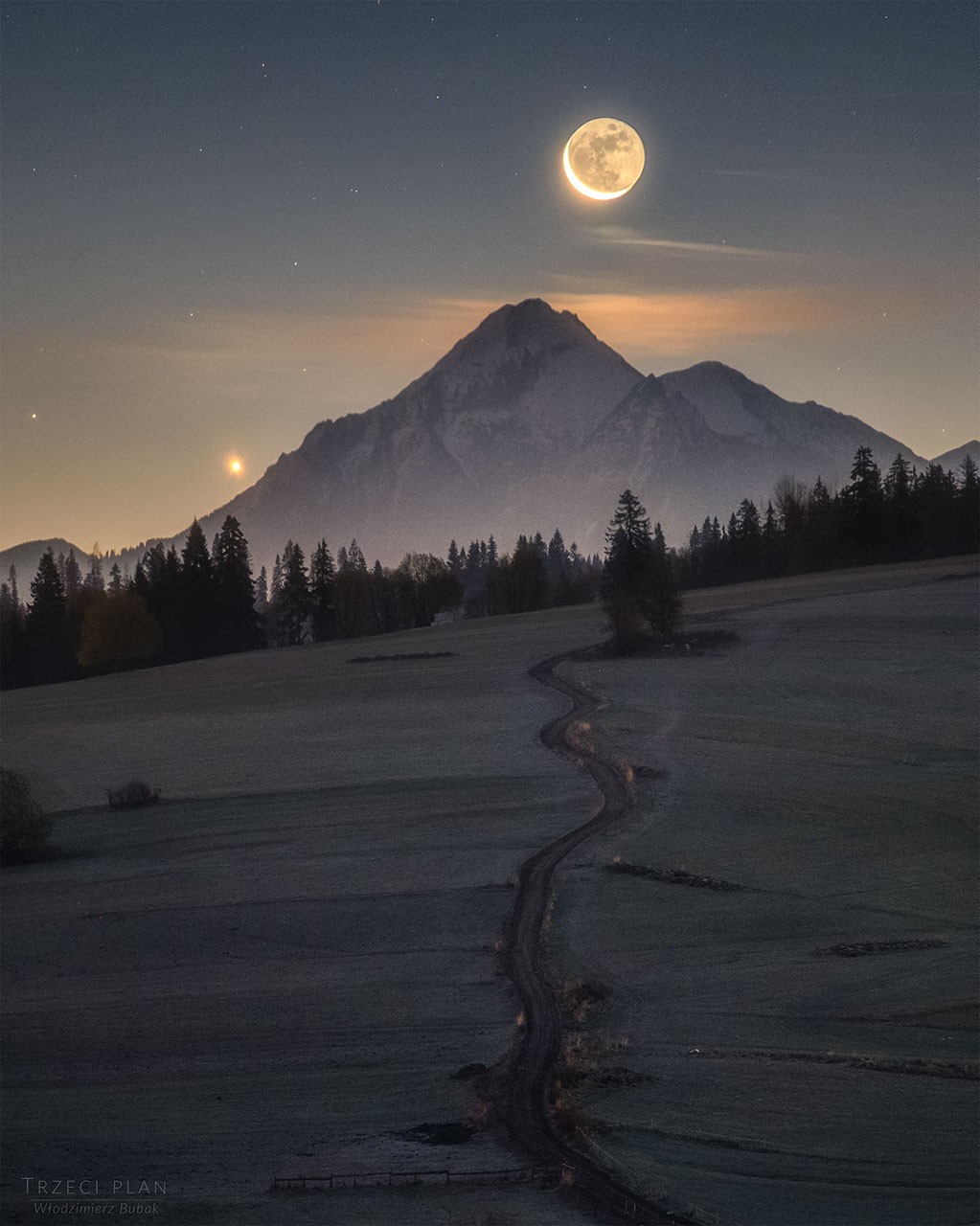
Above the snow-spined Tatra Mountains in Poland, the night of November 12, 2026, brought an arresting vision: a crescent Moon floating serenely, bright Venus radiant just beneath it, and to the left, the star Spica glimmering in the constellation Virgo. This luminous trio was no accident, but a fleeting conjunction, a phenomenon written into the rhythms of the cosmos yet rare enough to stop skywatchers in their tracks.
Planets on the Move
The spectacle delivered a lesson in the ceaseless wandering of planets. “Planet” itself, rooted in the Greek for “wandering star,” describes objects whose paths twist against the fixed constellations. As Venus traced its loop about the Sun, it drifted from our perspective into close alignment with the Moon and Spica. Such meetings, astronomers note, are not random — their timing and placement can be predicted centuries in advance through the mechanics of orbital motion.
Between Appearance and Reality
From Earth, the trio appeared close-set, almost touching. In truth, these were distant neighbors. Venus, the brightest planet in our sky, was separated from the Moon by millions of miles, and Spica stood even farther — approximately 250 light-years away. This illusion of proximity emerges only when Earth, Venus, and the Moon align along the same line of sight, a reminder of the artistry geometry can paint across the heavens.
The Star Whose Secrets Unfolded
Spica’s role in the night’s display carried its own historical resonance. Identified in 1890 as a binary — two hot blue giants locked in a dizzying orbital dance every four days — Spica this year revealed a deeper complexity. Astronomers recently reported that Spica is, in fact, a triple-star system, altering old notions of what gleamed alongside Venus that night. These discoveries sharpen our sense of how much yet lies hidden even in sky’s brightest beacons.
A Global Skywatch
Images of the conjunction surfaced from multiple vantage points. NASA’s photographers caught the Moon and Venus side-by-side above the Washington Monument on May 18, 2026, their pairing striking against the city’s skyline, while in Poland the Tatra peaks framed the cosmic triad. The SKYCAL Sky Event Calendar, maintained by NASA’s Goddard Space Flight Center, had flagged these conjunctions for months, providing the computed timing that allowed enthusiasts to look up at precisely the appointed hour.
Awaiting the Next Gathering
Celestial conjunctions — fleeting, governed by deep and calculable rhythms — remind us that the universe’s wonders are both predictable and infinitely surprising. While the Tatra image froze a moment now passed, astronomers and skywatchers alike look onward, calendars in hand, for the next rare alignment to etch its mark against the night.