
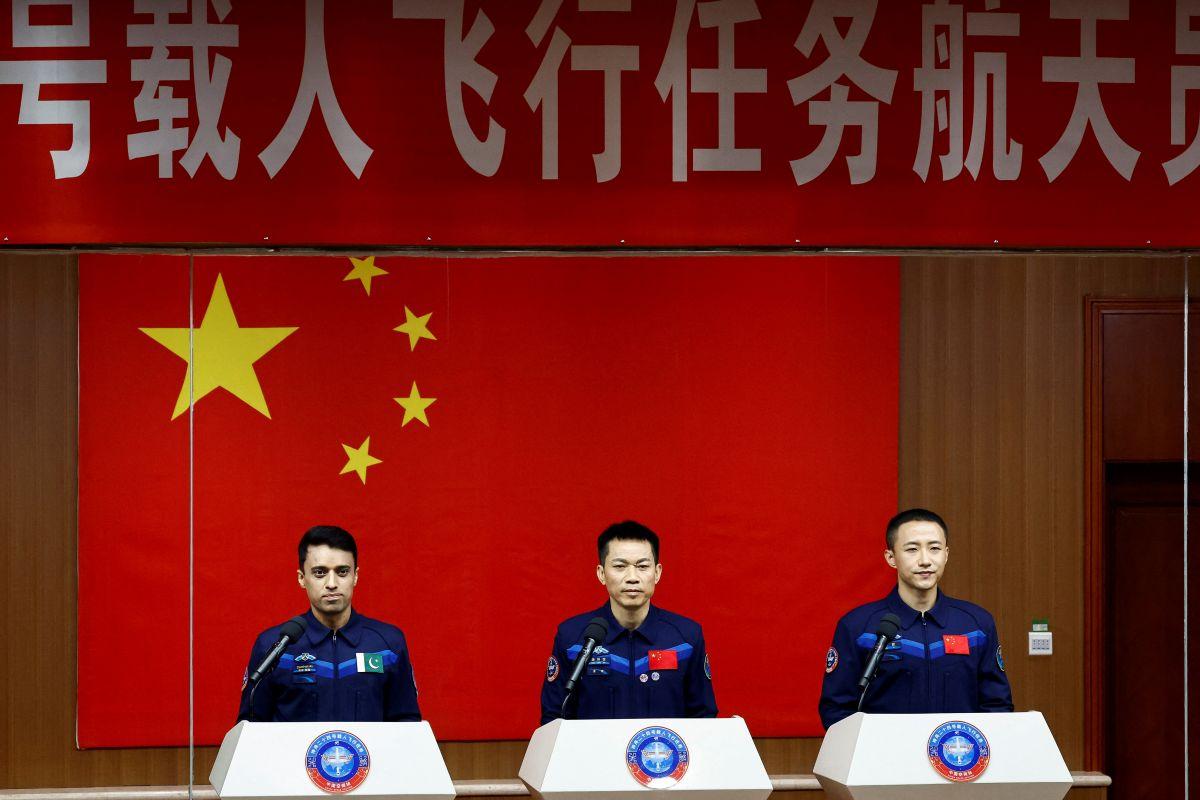
China is poised to mark a major milestone in its human spaceflight program, with the scheduled launch of the Shenzhou-24 mission on November 25, 2026, set to carry Pakistan’s Muhammad Zeeshan Ali—the first foreign astronaut aboard the nation’s Tiangong space station. Liftoff is targeted for 8:18 a.m. Beijing time from the Jiuquan Satellite Launch Center in Gansu Province (source: space.com, gmanetwork.com).
Ali, a 40-year-old Pakistan Air Force pilot, will travel alongside mission commander Tang Hongbo, a veteran of two prior flights, and engineer Wu Yi, embarking on his inaugural journey to orbit. While Commander Tang leads the three-person crew, Ali will serve as payload specialist—conducting four joint China-Pakistan scientific experiments, including research into photosynthetic microorganisms and advances in biotechnology and materials science. Ali’s stay aboard Tiangong is expected to last about five days before he returns to Earth with the departing Shenzhou-23 crew (source: space.com, gmanetwork.com, ecns.cn).
The Shenzhou-24 mission materializes nearly two years after the signing of a bilateral agreement in February 2025 between the Chinese and Pakistani governments. That agreement opened the door for international collaboration aboard the Chinese orbital station, which has been permanently crewed since its completion in 2022.
In the days leading up to launch, Chinese officials confirmed that the Long March-2F rocket carrying Shenzhou-24 has been rolled out to the pad and all final preparations are on track. Reports indicate all crew members are in good health and launch operations are proceeding as planned (source: space.com, gmanetwork.com).
This mission’s significance extends well beyond technological achievement, as Ali’s presence marks the first time a non-Chinese astronaut will visit the Tiangong station. The move is widely seen as a symbol of China’s intent to broaden its partnerships in space and reflects deepening scientific ties with Pakistan, one of the first nations to answer Beijing’s call for collaboration.
It remains to be seen how the experiments undertaken by Ali will impact biotechnology and materials science research—outcomes that will be assessed after the mission concludes. For now, this flight stands as a high-profile milestone for international cooperation in orbit and a new dimension to China’s ambitions in human spaceflight. The global space community will be watching closely as China counts down to launch.