
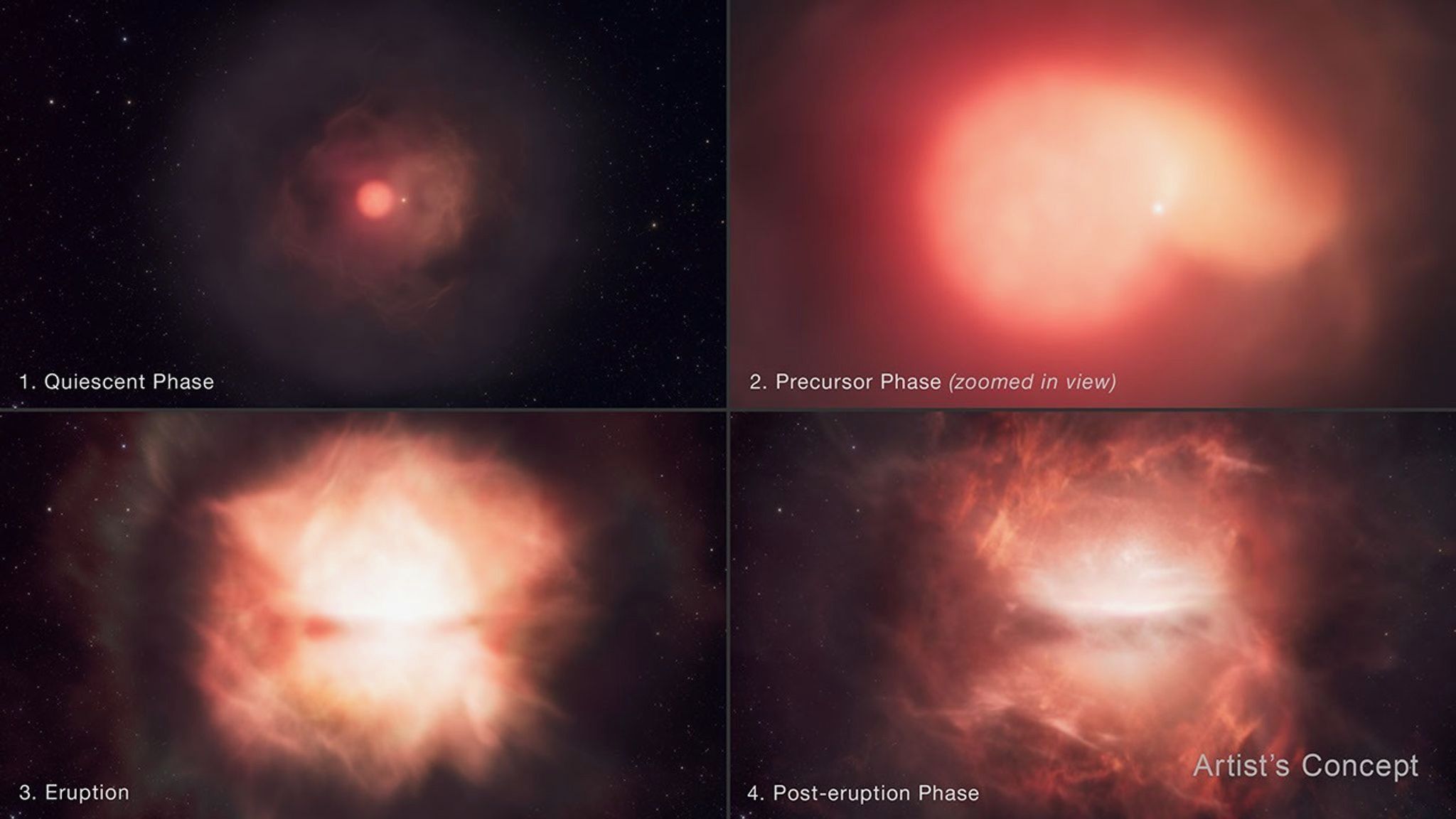
For the first time, astronomers have documented a star being engulfed by its giant companion in the Andromeda Galaxy, directly witnessing a process previously only theorized. The event, tracked across several years by ground-based and space telescopes, illuminates key aspects of how some of the universe’s most enigmatic binary star systems form and transform.
A Years-Long Death Spiral
The cosmic drama began around 2018, when a giant star in Andromeda—our nearest neighboring galaxy, some 2.5 million light-years away—was observed to gradually brighten. Astronomers monitoring the region noticed this unusual change, which indicated that a smaller companion star had begun to spiral inward, disrupting the larger star’s outer layers.
Over the next seven years, the system’s escalating brightness reflected the mounting heat and turbulence as the companion star orbited ever closer within its bloated partner.
Final Eruption Marks a Stellar End
This slow-motion collision culminated in October 2025 with a violent outburst: the pair’s brightness soared by a factor of 100 over just 25 days. Observatories worldwide, including the James Webb Space Telescope, caught the episode in progress, capturing a luminous red nova—an explosive, reddish burst associated with stellar mergers and interactions of this kind.
Infrared measurements revealed a rapidly expanding cloud of ejected dust, further confirming the destruction—and, potentially, the merging—of the two stars.
Unanswered Questions and Future Observations
Researchers remain unsure whether the swallowed companion was completely destroyed or if remnants still exist within the giant’s core. Ongoing observations aim to settle this question, with astronomers scrutinizing the system’s lingering heat, dust, and energy signatures for clues to its fate.
First Direct Window on a Common Cosmic Process
While the concept of “common envelope evolution”—in which one star drifts into the gaseous layers of another—dates back to the 1970s, this marks the first confirmed observation of the sequence in action. The milestone holds far-reaching implications for our understanding of binary star evolution, supernovae, and the formation of exotic objects like neutron star pairs and black holes.
The Andromeda event underscores the unpredictable, often violent mechanics that sculpt stars and galaxies—and gives astronomers a new blueprint for finding similar events elsewhere in the universe. Scientific attention now turns not only to the aftermath of this stellar devouring, but to the potential for more “death spirals” hidden in distant skies.