
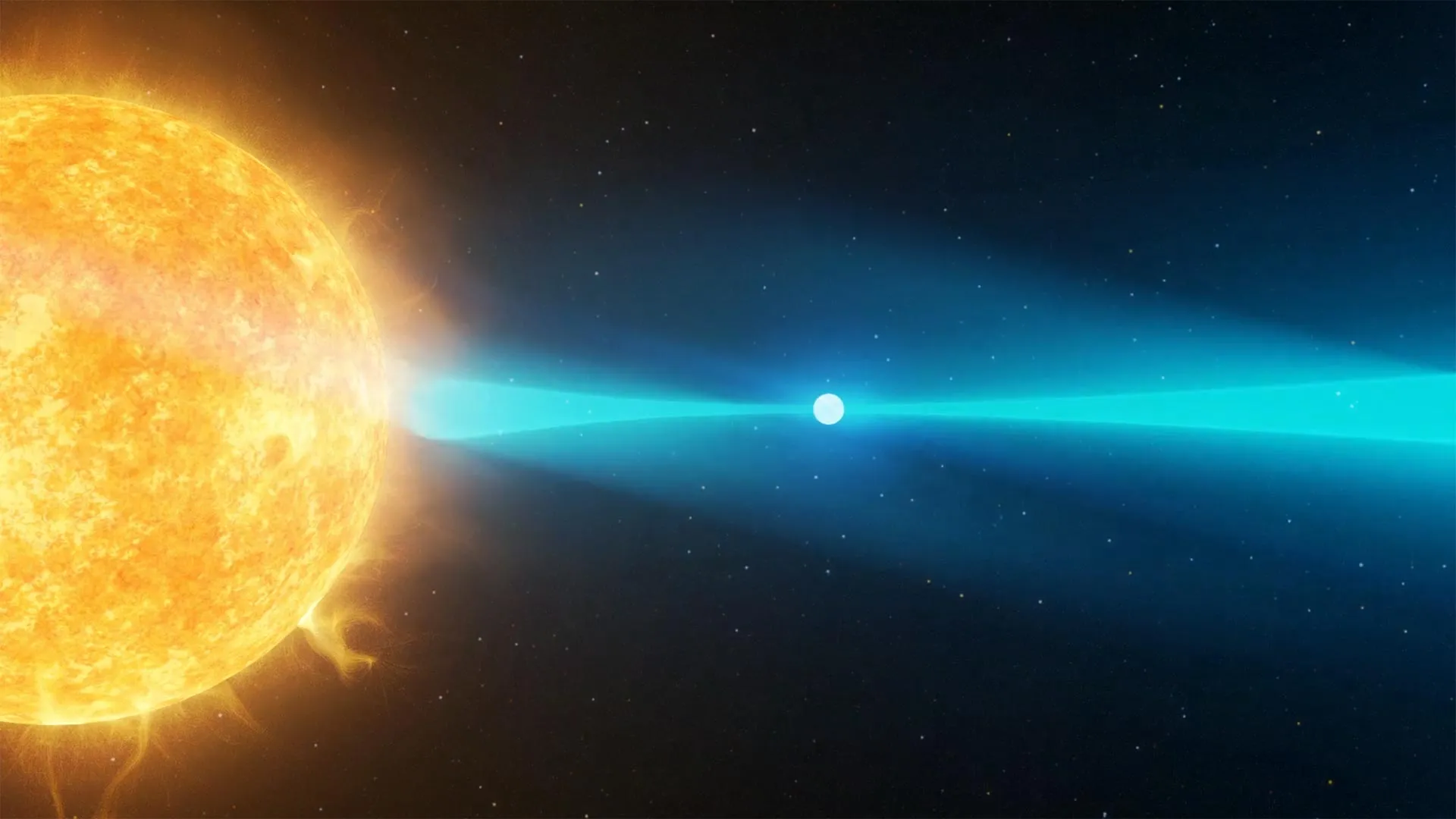
Astronomers have traced a series of mysterious radio pulses to an extraordinary binary star system, GPM J071507−114153, some 5,000 light-years from Earth—offering both a scientific breakthrough and a fresh enigma in the study of distant cosmic phenomena. In research published November 12, 2026 in Nature Astronomy, the team details their detection of radio signals that switch on and off every eight minutes, emanating from a rapidly spinning white dwarf orbiting a companion star strikingly similar to our Sun.
The discovery began with a systematic search in 2022, when astronomers identified strange, regularly recurring radio signals coming from the direction of GPM J071507−114153. These signals, labeled long-period transients (LPTs), have previously been associated with white dwarfs paired with red dwarf stars. This new detection marks the first documented case involving a Sun-like, G-type star—expanding the catalog of cosmic objects known to generate such emissions and challenging prior expectations about binary star dynamics.
To pinpoint the signals’ source and dynamics, researchers leveraged over 100 hours of high-sensitivity radio telescope observations from facilities in Australia and South Africa. The data revealed that the white dwarf, a super-dense stellar remnant, rotates every eight minutes. With each revolution, the star emits a burst of radio energy, illuminating its astronomical neighborhood in regular, pulse-like intervals. These radio emissions switched on and off over hours-long cycles, producing the characteristic LPT signature.
Aside from confirming the source, the study uncovered additional cosmic drama: massive magnetic storms raging on the surface of the Sun-like companion star. The powerful magnetic interactions between the white dwarf and its partner are now thought to play a vital role in shaping the system’s radio emission profile, though the precise physical processes remain a topic for future inquiry.
The publication solidifies GPM J071507−114153 as a new reference point in the search for unusual cosmic transients. While the current findings shed light on the dynamic interplay between white dwarfs and their companions, the full mechanisms behind these regular radio outbursts are yet to be conclusively explained. Astronomers plan ongoing monitoring of this enigmatic system, hoping to better understand how such magnetic relationships can give rise to the universe’s most tantalizing radio phenomena.
This remarkable case continues to add fuel to the field’s growing archive of puzzling space signals—and underscores the abundance of still-unwritten chapters in the science of stellar evolution and interstellar communication.