
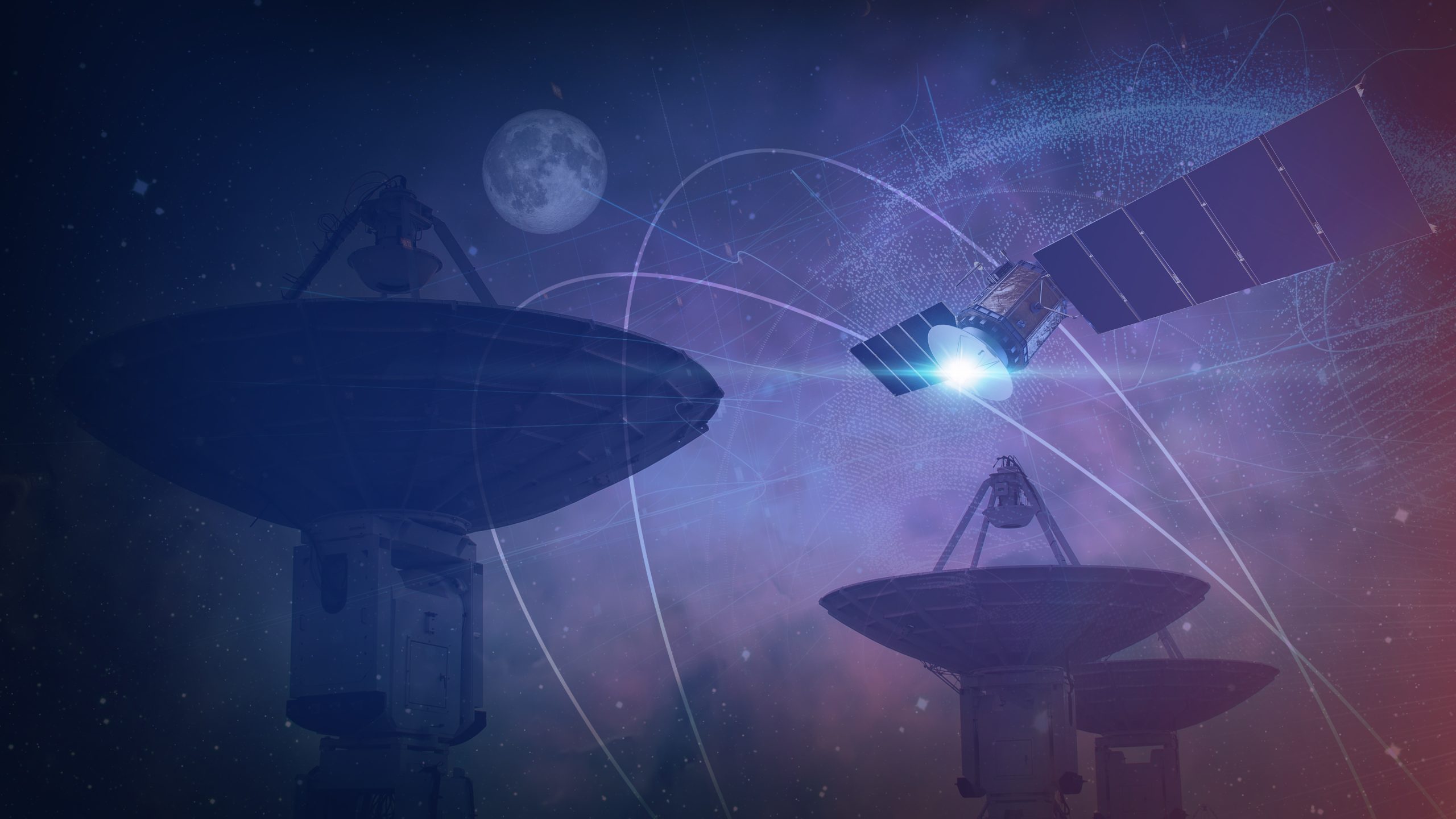
Photo: NASA/Dave Ryan
The global drive to build secure, sustainable space communications accelerated this month as agency officials, researchers, and private companies unveiled fresh initiatives aimed at transforming the backbone of satellite connectivity—and addressing its vulnerabilities—in a rapidly evolving orbital landscape.
On November 9, 2026, Viasat, a major U.S. satellite internet provider, confirmed it was awarded a Phase 1 contract under NASA’s Network Extension for User Continuity and Sustainability (NEXUS) initiative. The project aims to develop small geostationary orbit (GEO) satellites supporting next-generation relay networks, expanding the reach and resilience of NASA’s Near Space Network, which currently supports over 100 missions within 1.25 million miles of Earth. Viasat joins a crowded field of contenders as the U.S. agency seeks to leverage commercial capabilities to strengthen communications between Earth, the Moon, and deep space missions (nasa.gov; viasat.com).
European Push for Quantum Security
Europe, meanwhile, is betting on quantum technology to protect sensitive institutional and government communications from eavesdropping in the coming decades. The European Space Agency (ESA) announced on May 29, 2026, the launch of its Security And cryptoGrAphic (SAGA) mission, an ambitious effort in its preliminary design phase to demonstrate secure, space-based quantum key distribution (QKD). SAGA aims to deliver operationally viable solutions at both orbital and ground levels, directly responding to exposed vulnerabilities—such as those highlighted in a recent CSIS analysis which found numerous satellite command links remain unencrypted, leaving them open to interception and malicious intervention (esa.int; csis.org).
Building for a Crowded, Sustainable Future
Both sides of the Atlantic increasingly frame their investments within a context of sustainability and the emerging 6G communications era. The Secure World Foundation, in a June 2026 report, stressed the need for coordinated space traffic management and debris mitigation to ensure that satellite networks—crucial for both Earth-based infrastructure and deep space exploration—remain viable and secure for future generations (swfound.org).
ESA’s Advanced Research in Telecommunications Systems (ARTES) 4.0 program continues to pour resources into resilient satellite communication architectures, targeting government and infrastructure security, while the agency’s Moonlight project is laying the groundwork for a lunar satellite constellation by 2030 to support navigation and communications around the Moon (resilience.esa.int; esa.int).
Amid these public sector moves, private capital is also flooding into the ground infrastructure needed to handle the growing volume and sensitivity of space data flows: in early November, Northwood Space, a California-based ground station start-up, raised $375 million to expand its antenna network and support the next generation of missions (axios.com).
Pace of Innovation, Pace of Threat
While research proposals abound—spanning quantum-secured networks, physical layer security for IoT in Low Earth Orbit, and multi-layer sustainability strategies—it remains clear that both technical and policy solutions must keep pace not just with soaring ambitions, but with the potential for disruption. The next decade is poised to reshape the way humanity connects across space, but the race to build secure, sustainable systems is only just beginning—and the stakes reach far beyond science and exploration.