
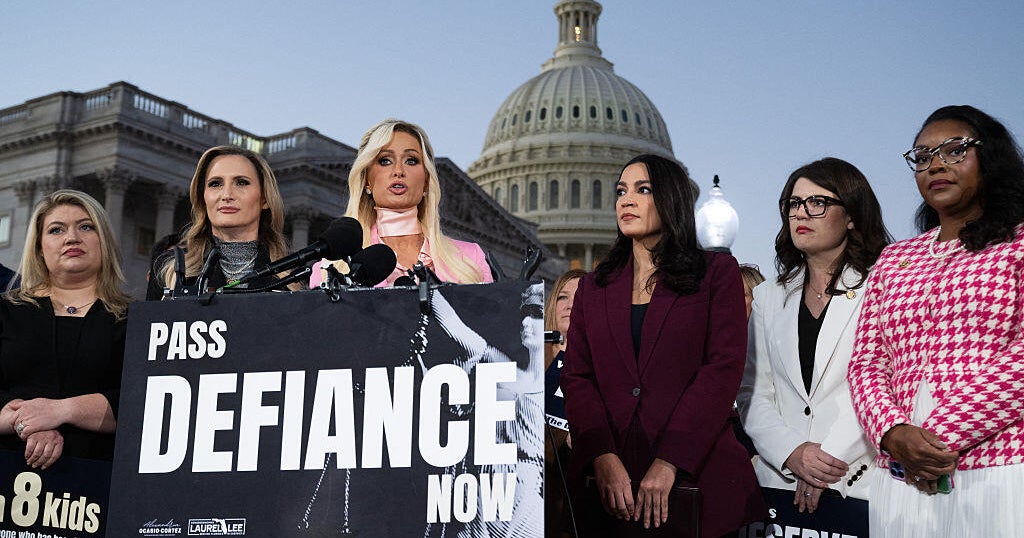
Paris Hilton returned to Capitol Hill on November 17, 2026, intensifying her campaign for congressional action against the fast-growing threat of non-consensual AI-generated sexual deepfakes. Joined by Representatives Alexandria Ocasio-Cortez (D-NY) and Laurel Lee (R-FL), Hilton made a direct appeal for the House of Representatives to advance the DEFIANCE Act—a bipartisan bill designed to give victims of such deepfakes the power to sue creators and distributors.
The urgency of Hilton’s advocacy comes as the legislation, formally known as the Disrupt Explicit Forged Images and Non-Consensual Edits Act, has languished in the House since passing the Senate unanimously in January. The bill would establish new legal rights for victims, including a 10-year window to file lawsuits and a provision allowing individuals to recover profits made from distributing AI-forged explicit material. Advocates, including Hilton, say these protections are overdue as rapid advances in artificial intelligence fuel the proliferation of manipulated images and videos online.
At the press conference, Hilton spoke of her own experience: at age 19, she found herself victimized by the distribution of intimate images without her consent. She warned that “taking down my deepfakes isn’t enough,” emphasizing the broader public threat. According to findings from Hilton’s team, the issue extends well beyond celebrity victims; of the 156 women currently serving in the 119th Congress, 83 have reportedly been targeted by sexual deepfakes—a statistic highlighting both the personal reach and the political urgency of the crisis.
Estimates cited by Hilton suggest that more than 50 million people have faced similar exploitation worldwide. Lawmakers and advocacy groups warn that women in public life are especially vulnerable. During her appearance, Hilton called upon House Speaker Mike Johnson, Majority Leader Steve Scalise, and Judiciary Chairman Jim Jordan to put the bill to a floor vote.
Legislative Stalemate Despite Bipartisanship
The DEFIANCE Act enjoys bipartisan sponsorship and previously sailed through the Senate with no opposition. Yet, supporters express frustration at the House’s inaction, calling on leadership to recognize the growing harm from unregulated AI image technologies. The legislation’s current stalemate has prompted Hilton and congressional supporters to escalate their push for a vote, warning that momentum and public trust could be lost without prompt action.
Hilton’s Capitol Hill appearance is her second major advocacy effort of 2026, following a previous plea in January. As deepfake technologies become more accessible and convincing, those supporting the bill argue that legislative gaps are leaving both public figures and everyday citizens exposed to devastating personal and reputational harm. The outcome now rests in the hands of House leaders—and in growing public awareness driven by advocates demanding action.