
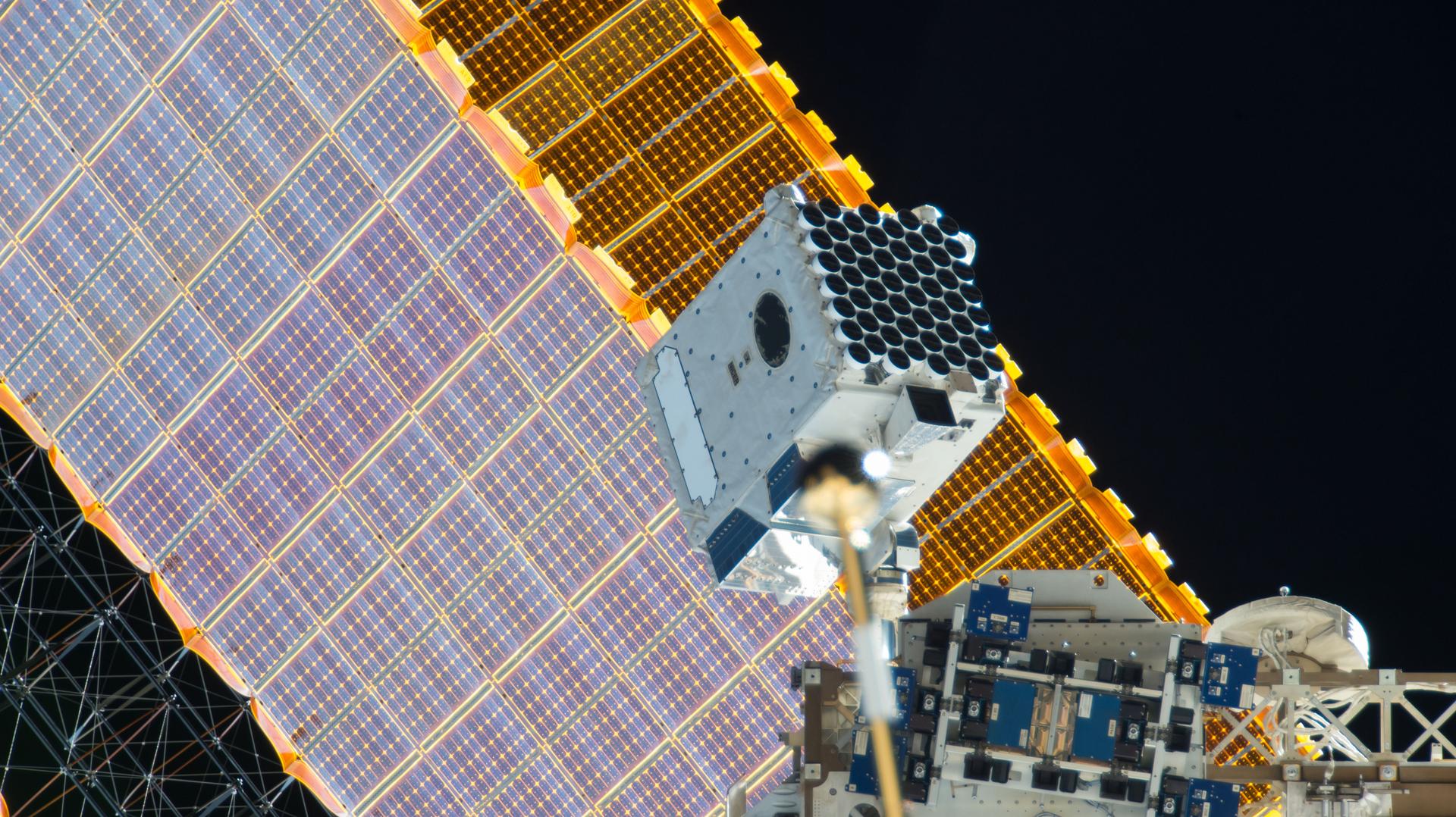
Photo: NASA/Nick Hague
The arc of NASA’s Neutron star Interior Composition Explorer (NICER) telescope closed this week, not with fanfare but with a quiet technical reckoning: after over six transformative years exploring the densest objects in the universe from its platform on the International Space Station, NICER ended its science operations, concluding a mission that outlived its original promise and altered X-ray astrophysics.
Unraveling the Densest Mysteries
NICER, launched aboard a SpaceX Falcon 9 in June 2017 for an anticipated 18-month mission, extended far beyond its original charge. Its X-ray measurements of neutron stars—the remains of collapsed massive stars squeezed into city-sized spheres—offered scientists unprecedented precision on the mass and radii of these enigmatic objects. The instrument’s sensitivity let researchers test decades-old nuclear physics theories by directly probing matter in the universe’s most extreme conditions.
Turning Points: Repair, Recovery, and Limits
The road was not without setbacks. In May 2023, a “light leak” damaged the telescope’s thin thermal shields, allowing sunlight to seep in and distort daytime measurements. A spacewalk in January 2025 allowed astronauts to patch the worst damage, and engineers developed a new detector configuration that restored over 70% of daytime observation capability. Yet, by June 2025, NICER suffered a far more crippling blow: the telescope could no longer swivel side to side, dramatically narrowing its cosmic gaze. Teams halted operations to investigate, using external ISS robots to photograph the instrument for clues. Their conclusion—that an internal motor had failed—ended hopes of full recovery.
Pushing the Boundaries of Navigation and Technology
NICER wasn’t just an observatory. With its SEXTANT enhancement, the payload delivered the first successful demonstration of autonomous X-ray-based navigation using pulsars, a milestone that could chart the course for future missions to Mars or beyond. Its innovative timing and spectroscopy instrument set a new benchmark, delivering photon detection with 100-nanosecond precision and opening tools for investigations beyond astrophysics.
Some of the very systems developed to calibrate NICER now seed real-world prototypes, including portable CT scanners and advanced materials analysis tools—an echo of the mission’s technological reach closer to Earth.
From Hardware Anomaly to Scientific Legacy
With the primary science drawdown, current efforts focus on securing NICER’s vast eight-year trove of X-ray observations and preparing for the spacecraft’s eventual removal from its ISS perch. Data from NICER’s guest observer programs and rapid-response observations—enabled, until recently, by its flexible pointing and integration with the OHMAN (Orbiting High-energy Monitor Alert Network)—remain a resource for researchers confronting the mysteries of compact objects and high-energy cosmic phenomena.
Although recovery attempts could not surmount the mechanical failure, NICER’s extended run has furnished new answers to a fundamental cosmic question: how big, and how strange, are neutron stars, when examined at the brink of physical law?
The Next Open Question
NASA’s closure of NICER’s science chapter leaves one closure yet to be managed: how—and when—the telescope will be physically decommissioned and detached from the International Space Station, a matter now under engineering review.