
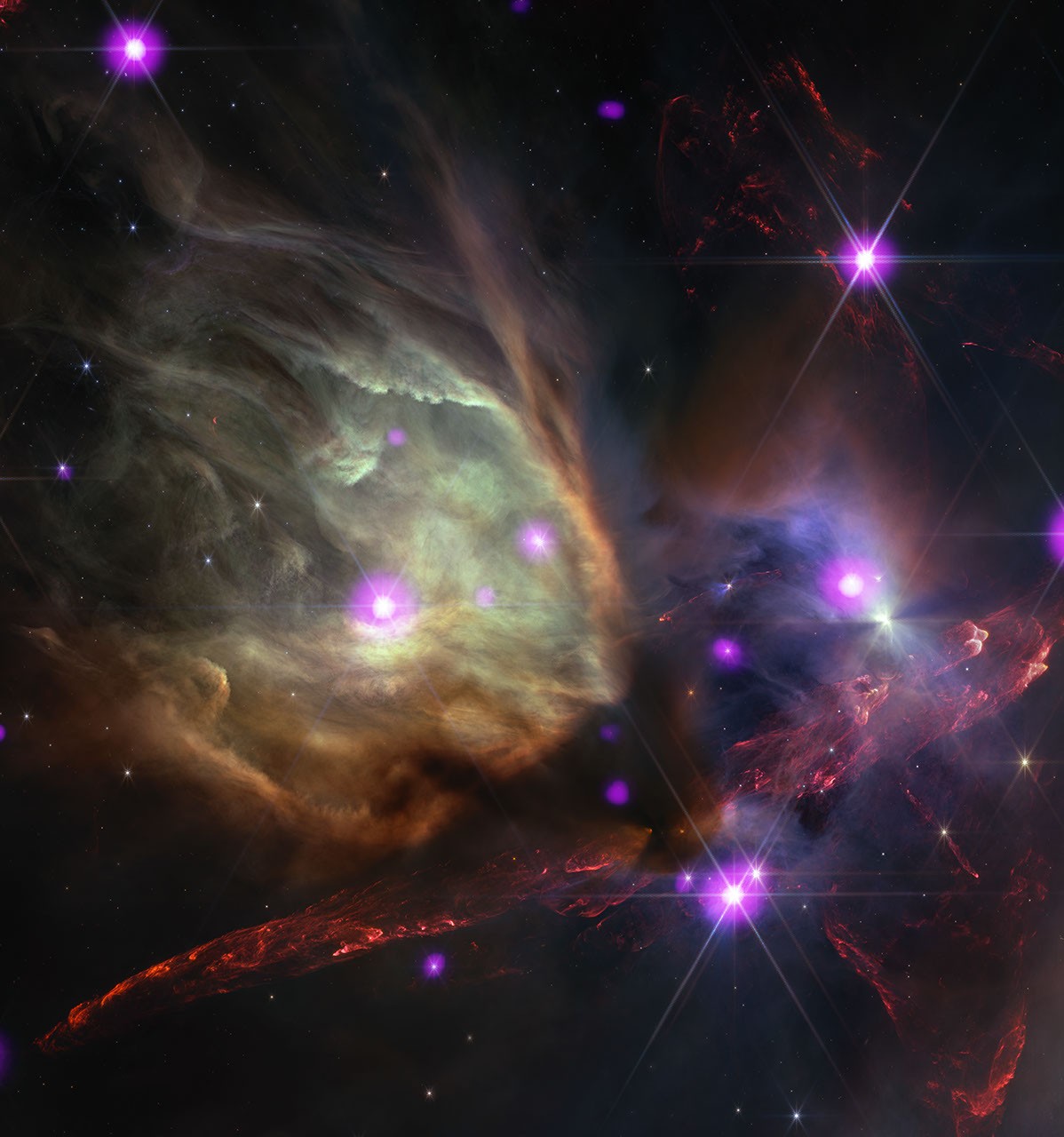
Photo: NASA/CXC/SAO/K.Arcand, SYSTEM Sounds (M. Russo, A. Santaguida
From explosive galactic cradles to the closest bustling nursery of stars, a new effort by NASA’s Chandra X-ray Observatory has brought the cosmos to Earth in an unprecedented form: music. On November 17, 2026, NASA released a new digital “album” of the universe’s baby star regions, transforming complex data from four star-forming sites—M82 galaxy, Orion Nebula, Carina Nebula, and Rho Ophiuchi—into evocative soundscapes.
This project, led by a collaboration between Chandra’s visualization scientist Kimberly Arcand and the audio-visual collective SYSTEM Sounds, goes far beyond artistic flourish. By assigning musical attributes to data from NASA’s suite of space telescopes—including Hubble, Webb, and the retired Spitzer—researchers have made high-energy, otherwise invisible cosmic phenomena accessible to our ears. For instance, X-ray emissions, captured uniquely by Chandra’s observatory (which boasts eight times the resolution and 20-times the sensitivity of previous X-ray telescopes), are mapped as shimmering tones, while data from infrared telescopes become low drones or digital harp plucks.
Among the selections, the M82 galaxy—a distant, starburst galaxy undergoing a frenetic pace of star formation—turns into a dynamic scan with sounds varying in pitch and texture based on the brightness and wavelength of its features. Chandra’s view reveals immense, hot plumes of gas from young stars exploding, their tumult rendered audible through rising frequencies.
The Orion Nebula, one of Earth’s closest and most heavily populated stellar nurseries, becomes a twinkling tapestry of musical notes. Chandra observes over a thousand infant stars in this region, their high-energy infancy translated into twinkling sounds, and the drama of diffuse gas rendered in pure high tones. The James Webb Space Telescope’s infrared gaze adds another layer: the building material of stars—dust and gas—appearing as deep, resonant strings.
In the Carina Nebula—home to the renowned “Cosmic Cliffs”—the sonification program weaves short string sounds for Chandra’s infant star detections, while the nebula’s vast, dust-carved cliffs and extended gas regions are embodied in a sustained, layered musical swell, punctuated to mark structural ridges and bright stars as distinct instruments.
Rho Ophiuchi, a striking mosaic of stars and swirling gas clouds, delivers another auditory journey. Here, newborn stars flashing X-ray flares become high-pitched glass tones, while the musical progression is interrupted by a gap: the silence corresponding to dust clouds that block nearly all light—an aural illustration of cosmic shadows.
The sonification team’s approach is grounded in rigorous science. Chandra, launched in 1999 and managed under NASA’s fleet of “Great Observatories,” provides essential insight into the hottest regions of the universe, tracing everything from star birth to supernova remnants and the swirling material around black holes. By converting data into sound, the program not only enhances accessibility for visually impaired audiences but also highlights crucial features—like stellar flares or dense star clusters—often overlooked in static imagery.
NASA’s Chandra program is operated from the Marshall Space Flight Center and the Smithsonian Astrophysical Observatory in Massachusetts, with ongoing contributions from both scientific and artistic collaborators. This blending of rigorous analysis and creative interpretation marks a growing trend in science outreach: making the universe palpable through multiple senses. Yet, as innovative as these sonic experiences are, they raise intriguing questions—chief among them, how might future sonification efforts further expand scientific understanding or engagement for both researchers and the public? For now, the album lets us listen in on the birth pangs of stars—a reminder of the universe’s ongoing symphony, ringing out far beyond the reach of our eyes.