
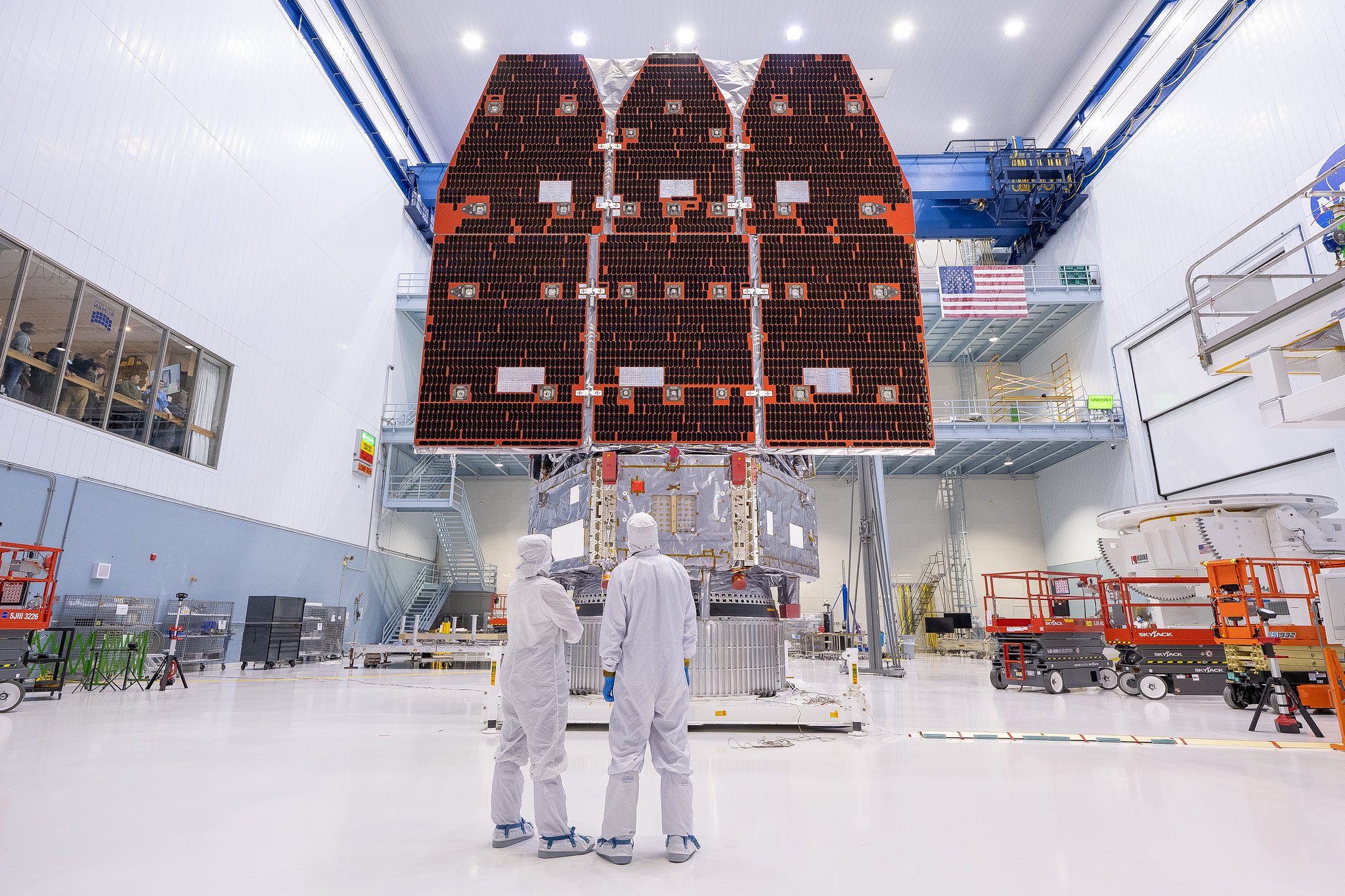
Photo: NASA/Jolearra Tshiteya
The countdown is over for a milestone in astronomical observation. On December 7, NASA will publicly unveil the first images captured by its Nancy Grace Roman Space Telescope, marking a major advance in the field’s ability to survey the cosmos in both depth and breadth.
The images, to be released during a livestreamed event from the American Geophysical Union (AGU) Annual Meeting in San Francisco, represent the arrival of a long-anticipated successor to the Hubble. Roman, launched aboard a SpaceX Falcon Heavy rocket from Kennedy Space Center on August 30, has completed its three-month, million-mile journey and undergone a rigorous commissioning process en route to its solar orbit at the second Sun-Earth Lagrange point, or L2, roughly 1 million miles from Earth.
What sets the Nancy Grace Roman Space Telescope apart is its combination of a 2.4-meter (7.9-foot) mirror—matching Hubble’s sensitivity—with an innovative Wide Field Instrument capable of imaging sky areas at least 100 times larger than Hubble’s infrared view in a single shot. Its 300-megapixel detector will, over the course of its mission, gather data on a billion galaxies and search the inner Milky Way for thousands of exoplanets via microlensing, offering both scope and precision previously unavailable to astronomers.
The unveiling will not only showcase Roman’s panoramic first light but launch a public initiative: individuals can ‘adopt’ a pixel from the maiden images, each representing a unique piece of the sky, and receive their own digital cosmic trading card—a move designed to deepen public engagement with science.
Roman’s mission targets some of the most profound open questions in astrophysics. The telescope is designed to probe the nature of dark energy and dark matter, directly image planets orbiting other stars via onboard coronagraph technology, and offer new possibilities in the search for worlds potentially suitable for life. Data from its wide and detailed surveys will feed both its own headline quests and a spectrum of research far beyond its official goals.
Preparation for this moment began with the telescope’s construction—including a crucial deployment of its Solar Array Sun Shield soon after launch to power and cool the spacecraft—and has relied on a global ground station and data retrieval effort. NASA teams, in partnership with institutions like Caltech/IPAC, the Space Telescope Science Institute, BAE Systems, L3Harris Technologies, and Teledyne, have been responsible for calibration, adjustment, and technology demonstration as Roman settled into its observing orbit. The European Space Agency and Japan Aerospace Exploration Agency are also contributing critical tracking and downlink support.
In recognition of Nancy Grace Roman, NASA’s first Chief of Astronomy known as the “mother” of the Hubble Space Telescope, the mission is positioned as Hubble’s “wide-eyed cousin.” Roman’s approach enables rapid mapping of the sky with the resolution of Hubble, but on an unprecedented panoramic scale, enabling discoveries that could elude narrower instruments.
While the first images will offer a spectacular preview of science to come, the upcoming years are expected to see Roman maximize its six-year nominal mission—possibly longer—by pushing the boundaries of both known and unknown in cosmic exploration.
For now, scientists and the public alike wait for the curtain to rise on Roman’s opening images, eager for a first look at an unfamiliar universe put sharply into focus, and for the discoveries that this new eye on the sky may soon unlock.