
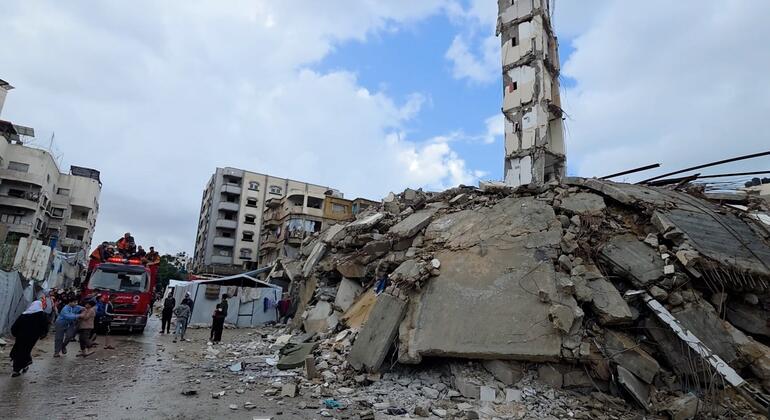
In a violent blow to Gaza’s battered health system, an Israeli airstrike struck the surgical department of Nasser Hospital in Khan Younis on Wednesday night, killing six people and wounding at least 27 more, according to United Nations and World Health Organization officials. The dead included a hospital worker, patients, and their companions. Ramiz Alakbarov, ad interim UN Special Coordinator for the Middle East Peace Process, described the attack as deeply alarming, emphasizing that international law forbids the targeting of hospitals and medical staff.
The damage extends beyond loss of life: Nasser Hospital, a key facility in southern Gaza, is now partially incapacitated just as the enclave’s medical needs deepen. WHO Director-General Tedros Adhanom Ghebreyesus condemned the strike, calling health centers “lifelines for its people that must be protected and never militarized or attacked.” The WHO notes that, since October 2023, over 1,000 assaults on healthcare facilities across Gaza have been documented.
As deadly violence intensifies, the context for civilian survival grows ever more precarious. Last weekend, severe storms battered Gaza, leading to widespread flooding and a fatal sand dune collapse. The UN Office for the Coordination of Humanitarian Affairs (OCHA) estimates that 1.4 million people—about 65 percent of Gaza’s population—are now living in tents or makeshift shelters, a situation compounded by limited heating and supplies as winter closes in. Reports confirm that a nine-month-old child died of cold exposure following several days of rain and flooding.
International aid efforts are struggling to bridge the gap. As of Wednesday, relief teams had distributed tents, tarpaulins, and blankets to about 1,800 families, only a fraction of the 5,200 families identified as urgently needing assistance. Meanwhile, access to essential medical equipment and lab supplies continues to be blocked, hampering efforts to control and diagnose disease outbreaks—critical in the winter months as standing water and sewage heighten risks.
Meanwhile, a separate strike on Thursday hit near UN facilities in Deir al-Balah, where staff were sheltering; all personnel were accounted for after the incident. On the diplomatic front, a coalition of 53 countries and organizations has called on Israel’s incoming government to permit unimpeded flow of humanitarian aid, stating that full delivery of promised assistance under the Security Council’s endorsed peace plan remains unrealized. As heavy rain threatens months of hardship ahead, calls for rapid action have grown increasingly urgent, with the central question remaining: Will aid reach Gaza before the next crisis unfolds?