
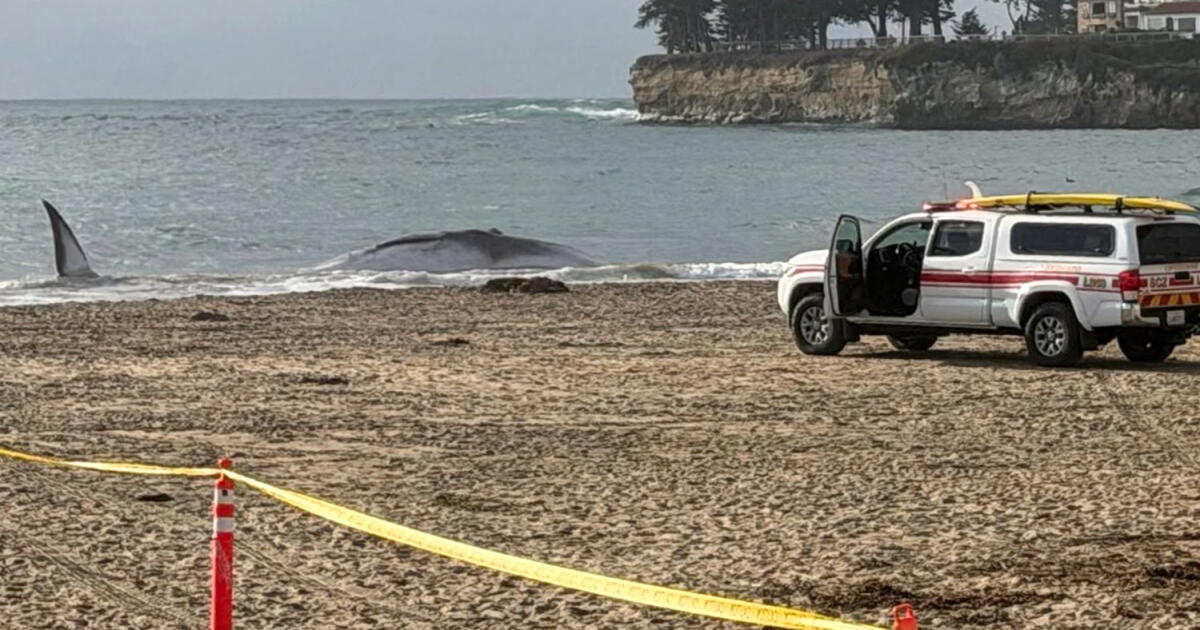
On the morning of November 12, 2026, beachgoers and first responders gathered near Cowell Beach in Santa Cruz witnessed a sobering sight: a massive, endangered fin whale had washed ashore alive, struggling in shallow surf just yards from the Santa Cruz Municipal Wharf. Within two hours, the weakened whale died, marking a grim milestone in what experts say is a troubling pattern for marine mammals along the California coastline.
Marine safety officials quickly closed the immediate area to protect both the public and the stricken animal, as response teams attempted what little could be done for a whale already in grave condition. Scientists from the UC Santa Cruz Long Marine Laboratory performed a necropsy soon after the animal’s death. Their initial findings confirmed what rescuers feared—the fin whale was severely underweight and showed telltale signs of long-term malnutrition. Samples collected will drive further analysis as researchers work to pinpoint the underlying cause of death, building on patterns seen in similar strandings up and down the coast over recent years.
Fin whales (Balaenoptera physalus) are the world’s second-largest whale species after blue whales, and are listed as endangered due to the legacies of commercial whaling and ongoing hazards such as ship strikes, entanglement with fishing gear, and changes in prey availability. Recent years have seen a spike in whale strandings on California beaches; experts cite shifting ocean conditions, food shortages, and increased marine traffic as likely contributing factors. In some cases, necropsies have pointed to chronic malnutrition as a primary factor, echoing what was observed in Santa Cruz this week. In others, ship collisions have been identified as the cause by independent media investigations and scientific agencies.
Local authorities in Santa Cruz responded rapidly, cordoning off beach access to support both emergency and research efforts. While the beached whale’s fate could not be changed, the decision to close access highlights the seriousness of such strandings for public safety as well as scientific study. As the whale’s remains begin to decompose, they will initiate a so-called “whale fall,” seeding the surrounding ecosystem with nutrients—a rare event that supports myriad marine life, but one also marking the loss of a vital individual from a struggling population.
The whale’s death, like others along the coast, has prompted renewed calls from researchers and conservationists for enhanced monitoring of California’s marine mammal populations and a better understanding of the threats they face. Until results from ongoing scientific tests return, the precise reason for this whale’s decline remains uncertain, though severe emaciation is a telling sign. With each high-profile stranding, evidence mounts of ongoing and complex challenges facing the region’s largest ocean dwellers.
Authorities continue to urge the public to avoid the area around Cowell Beach as the carcass is studied and, ultimately, dealt with. For now, the event stands as both a local tragedy and a reminder of the fragility of one of the planet’s most iconic endangered species along the California coast.