
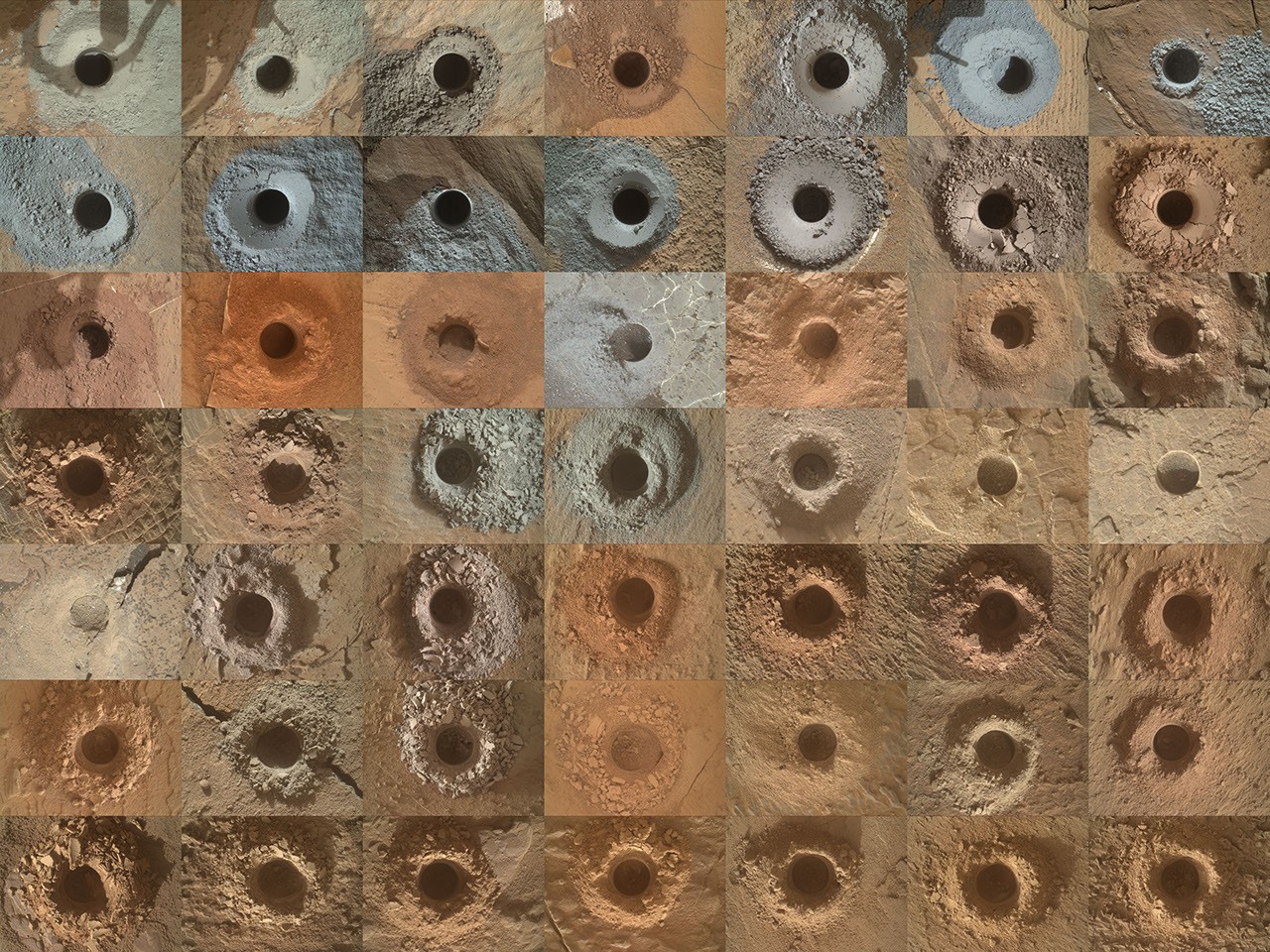
Photo: NASA/JPL-Caltech/MSSS
Each powder-ringed mark on Martian stone is a testament to endurance, precision, and the persistent hunt for answers about Mars’ distant past. As of November 2026, NASA’s Curiosity rover has punctured its 49th borehole in the red planet’s surface—a milestone that reveals the span and depth of the Mars Science Laboratory mission since Curiosity’s landing in 2012.
From First Hole to a Collage of Discovery
When Curiosity drilled its very first sample hole into a rock named “John Klein” on February 8, 2013, it was an untested move on alien terrain. That inaugural hole, 0.63 inches wide and 2.5 inches deep, marked the debut of a robotic technique for collecting rock powder directly on Mars. More than a decade later, a newly released NASA collage features 49 such boreholes—each a unique window into Mars’ geologic story, each captured by the rover’s Mars Hand Lens Imager (MAHLI).
The collage’s grid of dusty circles represents more than technical prowess. Each sample, extracted by the drill at the tip of Curiosity’s robotic arm, was delivered to the onboard Sample Analysis at Mars (SAM) and Chemistry & Mineralogy (CheMin) laboratories. There, the powdered rocks were analyzed for chemical and mineral signatures, leading early in the mission to the crucial discovery that ancient Mars had conditions capable of supporting microbial life.
Climbing Higher, Digging Deeper
Curiosity’s drilling campaign is not only a record of locations, but of Martian time and geology. The first drill site, “John Klein,” marked Sol 182 (Martian day) for the rover; the 42nd sample was extracted from “Kings Canyon” on August 3, 2024 (Sol 4,263). This longevity has allowed Curiosity to probe a continuous stratigraphic trail up the slopes of Mount Sharp, collecting evidence of environmental changes and tracking the transition from ancient lakeshores to more arid, windblown terrain. In August 2026, Curiosity reached a symbolic high point, registering a full kilometer of elevation gain above Gale Crater’s floor—a feat only possible through persistence and robotic ingenuity.
The evolving colors and textures around each drill hole, visible in the composite image, record the shifting chemistry of Mars’ rocks and soils. Over the 49 samples, scientists have charted variations in clay, sulfate, and other minerals, gradually piecing together a picture of a planet that once hosted water and the chemical ingredients for life.
Engineering and Collaboration on Earth and Mars
Behind every drilled sample is a network of terrestrial expertise. Curiosity’s drill and mobility systems were designed and assembled by NASA’s Jet Propulsion Laboratory (JPL), managed by Caltech, while the MAHLI camera—a critical tool for both documenting drill operations and examining sample sites—was built in San Diego by Malin Space Science Systems. Coordination between mission centers has been essential to adapt drilling parameters to evolving Martian conditions over the years, maintaining Curiosity’s drilling campaign even as the rover ages.
Unanswered Questions: What Will Sample 50 Reveal?
Despite this cascade of sampled sites, essential mysteries persist. Exactly how Mars’ habitable window closed, and whether any microbial life once thrived—these remain open questions that future samples and laboratory analyses aim to address.
As Curiosity readies for its 50th drill, each scar in Martian rock marks not just a technical achievement, but a stepping stone towards understanding Mars as a once-potential cradle for life. The rover’s voyage, methodically chronicled hole by hole, has transformed Gale Crater from a dusty mystery into one of the most thoroughly studied landscapes beyond Earth.