
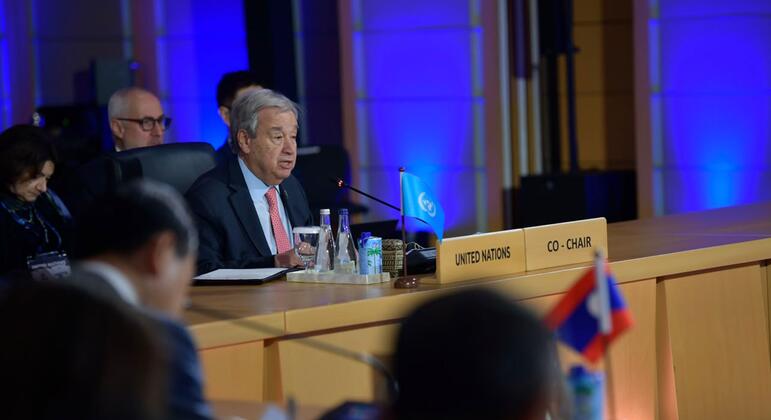
António Guterres used his final appearance as United Nations Secretary-General before the Association of Southeast Asian Nations (ASEAN) to deliver a pointed call for unity in the face of compounding regional crises, with a strong focus on the protracted conflict in Myanmar and the plight of Rohingya refugees.
Addressing the ASEAN-UN Summit in Manila on Monday, Guterres underscored the gravity of the situation in Myanmar, describing “human suffering [that] has reached epic proportions” nearly six years after the military’s coup ousted the civilian government. In his remarks, Guterres urged all parties to uphold international law, protect civilians, and to “allow safe, sustained and unhindered humanitarian access,” directly referencing the UN Security Council and General Assembly’s calls for the immediate, unconditional release of all those arbitrarily detained—including State Counsellor Aung San Suu Kyi.
The Secretary-General welcomed ASEAN’s continued efforts, particularly the ongoing work toward a Code of Conduct in the disputed South China Sea and support for a Cambodia-Thailand ceasefire. However, Guterres made clear that Myanmar remains Asia’s most urgent security and humanitarian crisis. He stressed support for ASEAN’s Five-Point Consensus peace plan—a framework adopted to address Myanmar’s crisis—but warned that, for the Rohingya minority, accountability and the conditions for “safe, voluntary, dignified and sustainable return” remain elusive almost a decade after mass displacement began.
Nearly 1.2 million Rohingya now reside in Bangladeshi refugee camps, following waves of violence most recently escalating in 2017. Guterres reminded ASEAN members of their duty to protect those fleeing persecution, noting that “States have a duty to protect those fleeing violence and persecution” until true repatriation is possible.
Beyond Myanmar, Guterres’s parting message encompassed wider geopolitical turbulence, referencing regional impacts from conflicts in Ukraine and the Middle East, and disruptions affecting supply chains and energy costs. He advocated reform of the United Nations Security Council and international financial institutions to better reflect 21st century realities—including the needs of ASEAN’s “rising economic and political powers.” The Secretary-General also emphasized confronting the climate emergency, urging accelerated transition to renewable energy and the development of inclusive, responsible artificial intelligence systems.
Guterres affirmed that his Special Envoy, Julie Bishop, would continue to pursue diplomatic engagement with all stakeholders, especially ASEAN, to seek a path out of Myanmar’s violence. As his term nears its end, Guterres leaves open the question of whether international and regional consensus can produce real movement toward peace—or at least relief—for Myanmar’s civilians and displaced minorities.